Floating doves to sunken ships: 18 of the most striking images of 2025
From floating doves and sunken ships to “Icarus” skydiving against the Sun, here is an art history expert’s guide to some of the most eye-catching photographs of the year.
1. Skydiver, Arizona
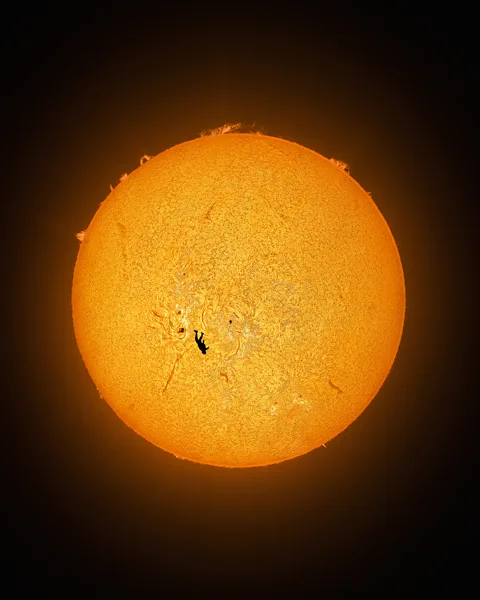
A remarkable image captured by astrophotographer Andrew McCarthy of his friend skydiving – silhouetted against an intensely textured snap of the morning Sun in Arizona on 8 November – caught the world’s imagination. There was no room for error, as every aspect of the carefully calibrated stunt had to go precisely as planned – a synchronicity of solar elevation, timing and plunging acrobatics. Quickly christened “The Fall of Icarus”, after the Greek mythological story of the boy whose wings melted when he flew too close to the Sun, the photograph vividly recharges a long tradition in art history, from Pieter Bruegel the Elder in the 16th Century to Henri Matisse in the 20th, of depicting the overreaching youth’s tragic descent. Peter Paul Rubens’s portrayal, which imagines the boy’s accelerating trauma, is particularly poignant.
2. Mountaineer, Nepal
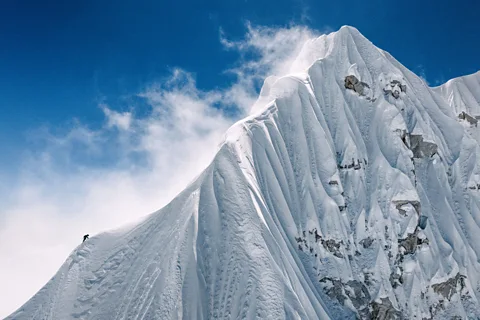
A photo of a French mountaineer in October, winding his difficult way towards the summit of Jannu East, an especially challenging 7,468m (24,501ft) Himalayan peak in Nepal, was widely shared online. Increasingly, avid climbers have found themselves scouring Nepal’s mountains looking for as-yet-uncharted paths to their alluring peaks. Dwarfed by the timeless pleats of ice and rock that starkly sculpt the mountain, the mountaineer’s imposing surroundings are as menacing as they are sublime. This terrifying diminishment of the human form amidst the groaning grandeur of the landscape calls to mind a forbidding watercolour by JMW Turner. His 1831 depiction of the remote Cuillin Hills on the Isle of Skye is similarly intensified by the vision of the raw majesty of nature and the utter puniness of man.
3. Destroyed pagoda, Myanmar
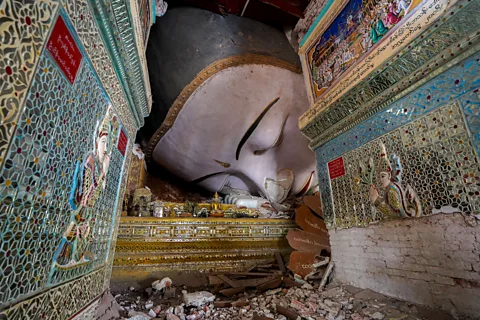
An affecting photo of a partially destroyed pagoda in Mandalay, Myanmar, which suffered a devastating 7.7 magnitude earthquake on 28 March, shows the fallen head of an enormous Buddhist statue. Tremors from the quake, which killed more than 3,000 people, were felt as far away as China, India, Vietnam and Thailand. The striking mismatch in scale between the teetering architecture that traps our gaze and the collapsed colossal statue, sealing off any escape at the back, is particularly powerful. The destruction caused by the seismic event will not soon be forgotten by those who survived it. Though the Portuguese painter João Glama Ströberle managed to free himself from a church whose mass he was attending when the 1755 Lisbon earthquake struck, in a sense he never escaped the devastation. He would spend the next three decades (1756–1792) planning and painting an elaborate tableau of the suffering and damage the earthquake caused.
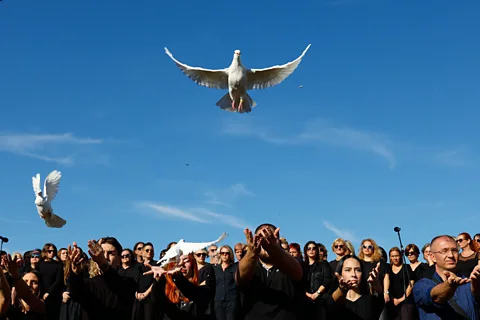
4. Flying dove, Serbia
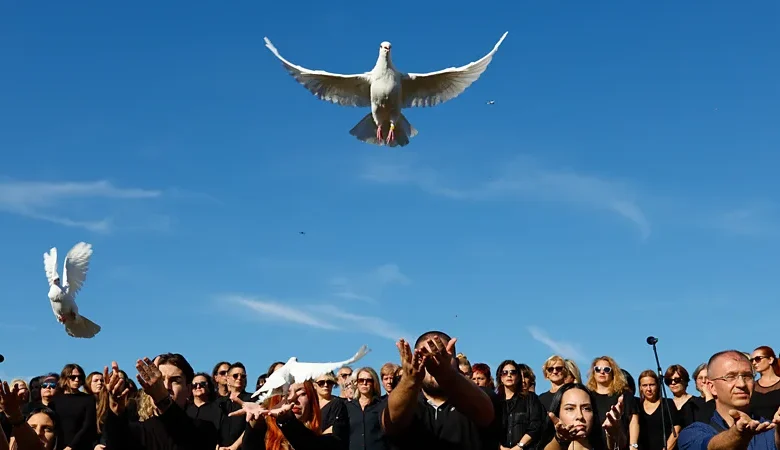
A large white dove seems weightlessly suspended over a group of people, whose hands are open as they release the birds into the air in Serbia on 1 November. The event was held to mark the first anniversary of the fatal collapse of a canopy in the Novi Sad railway station – a tragedy that killed 16 people. Organised by youths who alleged government corruption in the handling of the disaster, the ceremony also involved 16 minutes of silence to remember the victims of the collapse. The powerful simplicity of the dove, traditionally a symbol of love, innocence, and hope, aligns the affecting photograph with countless depictions of the bird in art history, dating back to prehistory and Iron Age art. An elegant line drawing of a dove by Picasso (who returned to the symbol again and again), encircled by a wreath of interlocking hands, is in accord with the spirit of the photo from Serbia.
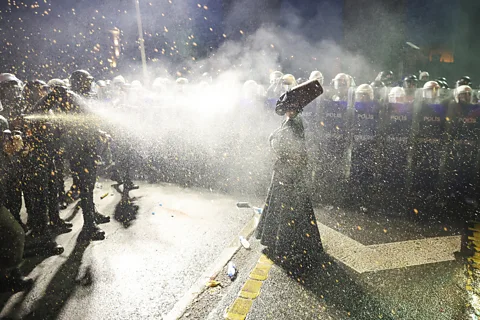
5. Protester, Istanbul
The image of a protester in Istanbul wearing traditional dervish attire – customarily associated with Sufi mysticism – confronting a battalion of heavily equipped police officers deploying pepper spray, went viral in March. The widespread political unrest, the most heated in over a decade in Turkey, was triggered by the arrest and jailing of Istanbul’s mayor – a figure seen by many as a rival to President Erdoğan. The visual juxtaposition of a seemingly stoic and motionless individual, linked to the non-violent spiritual practice of dervish whirling, and armed law enforcement is powerful. The distinctive tall dervish hat and long, layered robes, both rich in the symbolism of death and rebirth, elevated the image from one of typical street protest to something mythic. Distant recollections from art history of the dynamic dancing of dervishes serve only to unsettle the scene further.
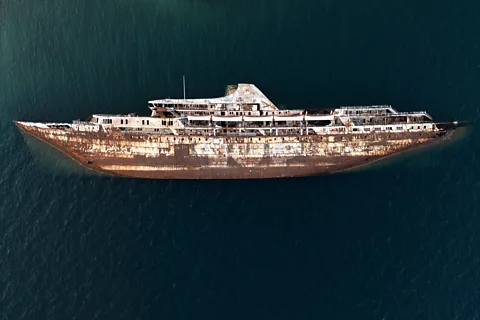
6. Abandoned cruise ship, Gulf of Elefsina
Neither of the sea nor free from it, the rusting husk of the abandoned cruise ship, the MS Mediterranean Sky, which capsised in the Gulf of Elefsina, west of Athens, in 2003, was photographed in August in its perpetual state of semi-submergence. For more than 20 years the vessel has remained half-sunk, slowly weathering into ragged oblivion. Captured in profile against a rippling canvas of liquid cobalt, the ship seems to teeter between elements, if not states of existence. Its static voyage echoes the ossified journey of an ancient Phoenician carving of a ship that adorned a 2nd Century ship sarcophagus – forever ferrying passengers between worlds.
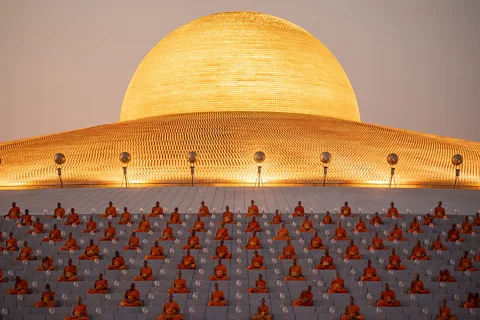
7. Monks praying, Thailand
A photo of monks praying beneath the vast golden dome of Wat Phra Dhammakaya during the yearly ceremony of Makha Bucha in February is breathtaking in its ethereal glow. Tens of thousands of monks and devotees, many holding lanterns, assemble to commemorate the Buddha’s first great teaching. Its unreal radiance calls to mind the contours of a 19th-Century Burmese manuscript depicting the Buddha’s first sermon at the Deer Park, where monks and animals cluster around his resplendent form. Both images capture the devotion of communities determined to honour and be transformed.
8. Water parade, Venice
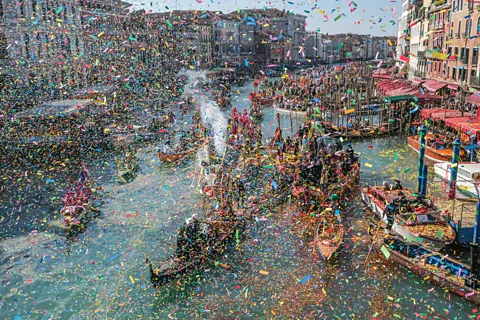
Photos of a giant, confetti-exploding papier-mâché rat, drifting down the Grand Canal in the water parade that traditionally opens the Venice Carnival in February, captured the scene in a shatter of vibrating colour. Rodent-turned-spectacle, the floating “Pantegana” emerges imaginatively from the city’s drains as an emblem of Venice’s comic underbelly. Disgorging bursts of colour, the rat offers a grotesquely glittery foil to the elegantly luminous shroud that veils Venice in countless paintings, such as neo-Impressionist Paul Signac’s Entrance to the Grand Canal, 1905. In both images, Venice dissolves into a mosaic of pixelated light.
9. Tomb of Pope Francis, Rome
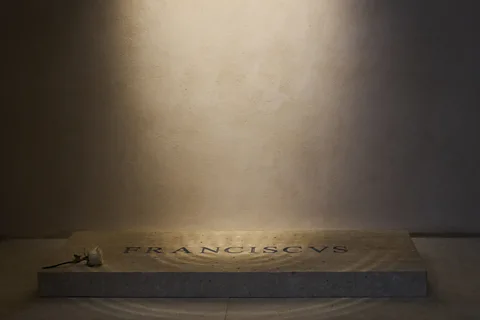
A photo taken in April of the tomb of Pope Francis in Rome – the first interment of a pontiff outside the Vatican in over a century – on which was laid a single white rose, was exquisitely haunting. The stark stone slab seems to shudder in fusty crypt light. The photo’s transcription of the eloquent gloom echoes the evocative mood of a 1798 drawing by JMW Turner of Cardinal Morton’s tomb in Canterbury Cathedral. Turner’s graphite-on-paper drawing feels lit by an ever-deepening inner radiance, which our eyes peel their way towards, one petal at a time. Both images see stone, like death, as permeable, inconclusive.
10. Migrant worker, Chandigarh, India
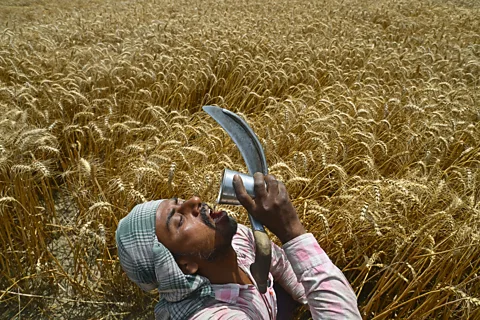
There is something inescapably archetypal about the photo taken in April of a migrant worker pausing to drink water while harvesting wheat on the outskirts of Chandigarh, India. The worker’s raised cup and sickle, glinting against the golden glow of grain, evoke the emblematic figure of the lone harvester in Winslow Homer’s The Veteran in a New Field, 1865. In Homer’s work, a Union veteran wields a scythe against a sea of wheat in a fable of national reckoning after the US Civil War. Both images locate their subjects between allegory and labour, harvesting not only grain but the enduring promise of renewal.
11. Robot hand, Beijing
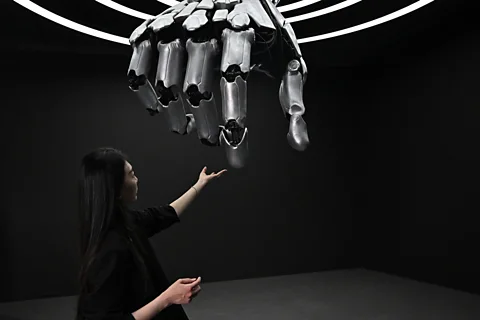
The image of a young woman reaching up to touch the slowly unclenching index finger of an enormous robot hand was captured during a press tour of Beijing’s World of Robots in April. The photo’s dramatic lighting and the figure’s black clothing conspire to diminish the sense of human presence to mere flickers of flesh: floating forearms and a sliver of profile suspended in darkness. At first glance, the near contact may evoke Michelangelo’s Creation of Adam, or perhaps, better still, MC Escher’s riddling drawing of hands drawing hands (1948). In the age of AI, the line between creator and created is harder and harder to grasp.
12. Transit centre, Buganda
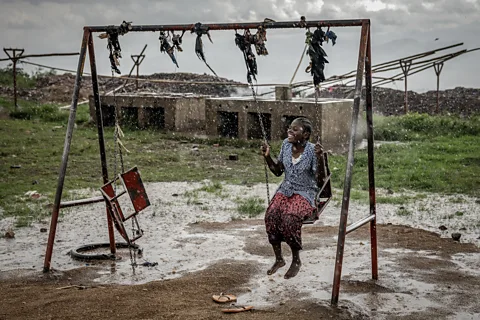
The image of a Congolese refugee sitting on a swing at a Transit centre near Buganda in May, vibrates with a joy that transcends the material discomforts to which it attests: the relentless rain, the rusting steel frame of the abandoned playground equipment, and the broken seat dangling beside her. With the woman among more than 70,000 people who crossed into Burundi since January, her spirit defies her difficult circumstances. Set the photo beside French Rococo artist Jean-Honoré Fragonard’s famous painting The Swing (1767), and it strips away the courtly frivolity of the famous work, reclaiming the swing as a timeless prop of playfulness and inner peace, suspended outside of space and time.
13. Meteor shower, Inverness, California
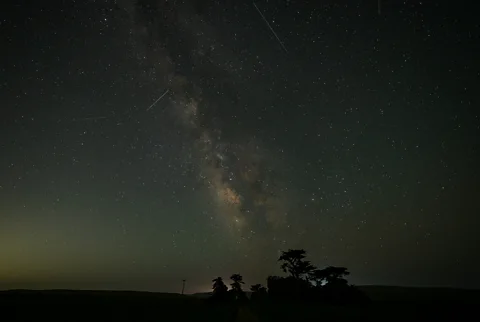
A photo capturing the Eta Aquariid meteor shower as it slashed through the night sky over Inverness, California, in the early hours of 6 May, was at once inspiring and humbling. Dwarfed by the glimmering blur of the Milky Way above it, the glow of a small hamlet appears little more than a flickering footnote in a vast cosmic drama. The affecting contrast between human and heavenly scales recalls Adam Elsheimer’s groundbreaking painting, The Flight into Egypt (c 1609), celebrated for its pioneering astronomical precision. In Elsheimer’s work, the Holy Family occupies only a fraction of the foreground as the eye is drawn upward to the immense night sky. Both images, centuries apart, attest not just to contemporary advances in optics but the perenniality of awe.
14. Oil-covered eyes, London
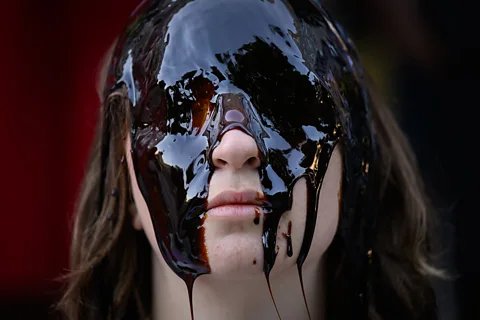
Covering her eyes in an unctuous, oil-like substance, an activist from the direct-action campaign group Fossil Free London placed herself outside the offices of the Shell energy company in May. Shell’s sale of its onshore oil assets in Nigeria – a move that protesters allege enables the company to dodge responsibility for accidents in the Niger Delta – triggered the demonstration. The company denies wrongdoing. The blindfold pose calls to mind George Frederic Watts’ Symbolist painting Hope, 1886, in which a woman, eyes covered, sits atop a murky globe, plucking a doleful lyre.
15. Diving swimmer, Singapore
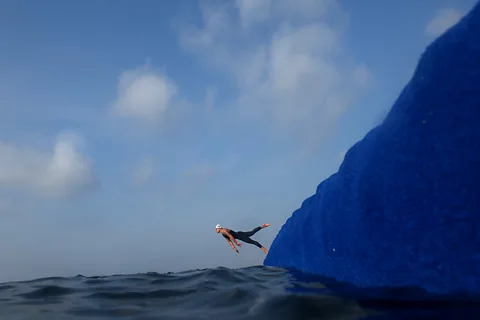
An almost immersive, water-level photo of Chinese swimmer Tianchen Lan, competing in an open-water relay at the World Aquatics Championships in Singapore on 20 July, freezes the athlete in mid-dive as he arcs from an ultramarine platform. The bold abutment of blues – sky, water, and platform – and the arresting suspension of the athlete’s body recall seemingly disparate aspects of French conceptual artist Yves Klein’s imagination: Klein’s creation in 1957 of a singularly intense hue, International Klein Blue, and his 1960 photomontage Leap into the Void. The latter creates the illusion of his body perilously plummeting from a Paris rooftop to the street below, like the Singapore photo, positing the body and the abyss as one.
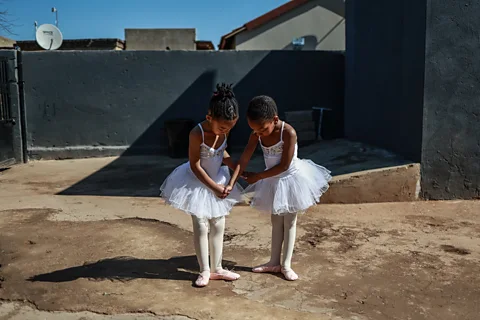
16. Ballet students, Tembisa, South Africa
A photo of two 5-year-old ballet students, Philasande Ngcobo and Yamihle Gwababa, posing in July outside a dance academy in Tembisa, South Africa, was powerful and touching. The stark contrast between parched ground, chiselled shadow and delicate dresses recalls the rigorous aesthetic angularities of Degas’s countless scenes of dancers in rehearsal. Keeping our eye fixed on the gestural gravity of his ballerinas, Degas often abstracted the dancing studios to swathes of blank colour, investing his paintings, like the photo from outside Johannesburg, with a timeless dimension.
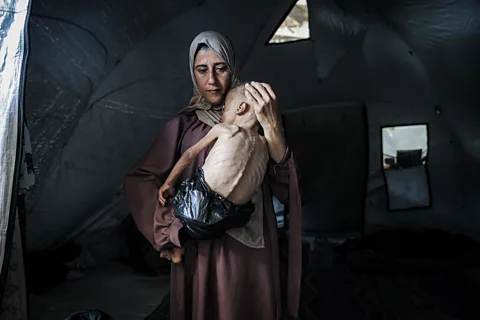
17. Emaciated child, Gaza City
A sequence of devastating images of emaciated children, cradled in the arms of their mothers in Gaza City in July, shocked the world. BBC News reported that, according to the UN’s Palestinian refugee agency (Unwra), one in five children in Gaza City was suffering from malnutrition. Publication of this image sparked controversy, after it was alleged that the child depicted in the photo also suffered from pre-existing medical issues that would account for his poor physical condition. While there are countless images in art history of mothers comforting afflicted children, from Dutch artist Gabriël Metsu’s The Sick Child, 1665, to Pablo Picasso’s pastel and charcoal drawing The Disinherited Ones, 1903, such photos as those captured in Gaza are without possible parallel in painting or sculpture. No visual invention of suffering or pity by any artist, however gifted or revered, can adequately encapsulate the scale of unfathomable anguish chronicled in these recent photos.
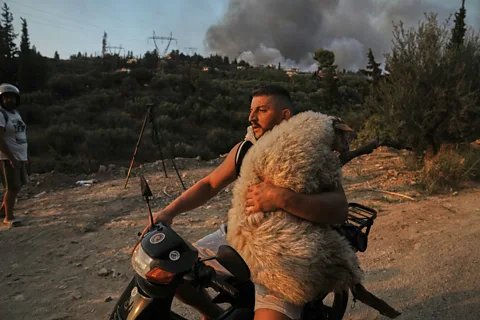
18. Sheep rescue, Patras, Greece
Against a backdrop of woolly smoke billowing from the wildfires that struck Patras in August, a man on a motorcycle is seen rescuing a sheep that clings to him for dear life. The gesture recalls early depictions of the Good Shepherd in the Roman catacombs of the 2nd and 3rd centuries, where Christ shoulders a vulnerable animal. Across ages, the recurring motif – whether preserved in fresco or captured in a photograph – reinforces the enduring mythical nature of heroism.