Fears of ‘slow, certain death’ stalk Tigray amid rumblings of renewed war
Saba Gedion was 17 when the peace deal that ended the conflict in her homeland of Tigray in northern Ethiopia was signed in 2022.
She hoped then that fighting would be a thing of the past, but the last few months have convinced her that strife is once again looming, and she feels paralysed with despair.
“Many people are leaving the region in droves,” Gedion told Al Jazeera as she sat under the shade of a tree, selling coffee to the occasional customer in an area frequented by internally displaced people (IDPs) in Tigray’s capital, Mekelle.
Gedion – herself a displaced person – is from the town of Humera, a now-disputed area with the Amhara region that witnessed heavy clashes during the 2020-2022 war between Ethiopia’s federal government and the Tigray People’s Liberation Front (TPLF).
The now-21-year-old remembers the horrors she witnessed. Some of her family were killed, while others were abducted into neighbouring Eritrea, she says. She has not heard from them since.
Though she made it out alive, her life was turned upside-down when she was forced to flee to Mekelle for safety.
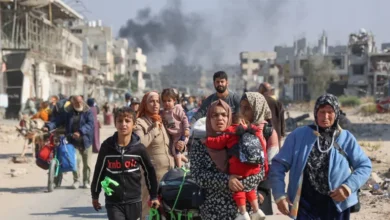
Years later, Gedion sees similar patterns as people leave Tigray – most headed to the neighbouring Afar region – once again looking for the safety that has become elusive at home.
“Recurring conflict and civil war have made us zombies rather than citizens,” she told Al Jazeera.
In recent weeks, enmity between Ethiopia and Eritrea has escalated amid separate accusations by both sides.
Speaking to Ethiopia’s parliament in early February, Prime Minister Abiy Ahmed addressed his landlocked country’s access to the sea, saying “the Red Sea and Ethiopia cannot remain separated forever”. This has led to accusations by Eritrea that Addis Ababa is seeking to invade its country and trying to reclaim the Red Sea Assab seaport, which it lost in 1993 with the independence of Eritrea.
“Many people are leaving the region in droves,” Gedion told Al Jazeera as she sat under the shade of a tree, selling coffee to the occasional customer in an area frequented by internally displaced people (IDPs) in Tigray’s capital, Mekelle.
Gedion – herself a displaced person – is from the town of Humera, a now-disputed area with the Amhara region that witnessed heavy clashes during the 2020-2022 war between Ethiopia’s federal government and the Tigray People’s Liberation Front (TPLF).
The now-21-year-old remembers the horrors she witnessed. Some of her family were killed, while others were abducted into neighbouring Eritrea, she says. She has not heard from them since.
Though she made it out alive, her life was turned upside-down when she was forced to flee to Mekelle for safety.
Years later, Gedion sees similar patterns as people leave Tigray – most headed to the neighbouring Afar region – once again looking for the safety that has become elusive at home.
“Recurring conflict and civil war have made us zombies rather than citizens,” she told Al Jazeera.
In recent weeks, enmity between Ethiopia and Eritrea has escalated amid separate accusations by both sides.
Speaking to Ethiopia’s parliament in early February, Prime Minister Abiy Ahmed addressed his landlocked country’s access to the sea, saying “the Red Sea and Ethiopia cannot remain separated forever”. This has led to accusations by Eritrea that Addis Ababa is seeking to invade its country and trying to reclaim the Red Sea Assab seaport, which it lost in 1993 with the independence of Eritrea.Unhealed scars of war
In Tigray’s capital, a once-booming city of tourism and business, most streets are quiet.
The young people who previously frequented cafes are now often seen applying for visas and speaking with smugglers in the hope of leaving Tigray.
Helen Gessese, 36, lives in a makeshift IDP camp on the outskirts of Mekelle. She worries about what will become of the already struggling region should another conflict erupt.
Gessese is an ethnic Irob, a persecuted Catholic minority group from the border town of Dewhan in the northeastern part of Tigray.
During the Tigray war, several of her family members were kidnapped, she said, as Eritrean troops expanded their hold of the area.
As the war intensified, she fled to Mekelle, about 150km away, looking for safety. Her elderly parents were too frail to join her on foot, so she was forced to leave them behind. Like Gedion, she has not heard from them or the rest of her family since 2022.
“My life has been held back, not knowing if my elderly parents are still alive,” she told Al Jazeera, the stress of the last few years making her seem much older than she is.
In Mekelle, it is not uncommon to meet people who are anguished or frustrated – some by the renewed tensions, and many by the trauma of the previous conflict.
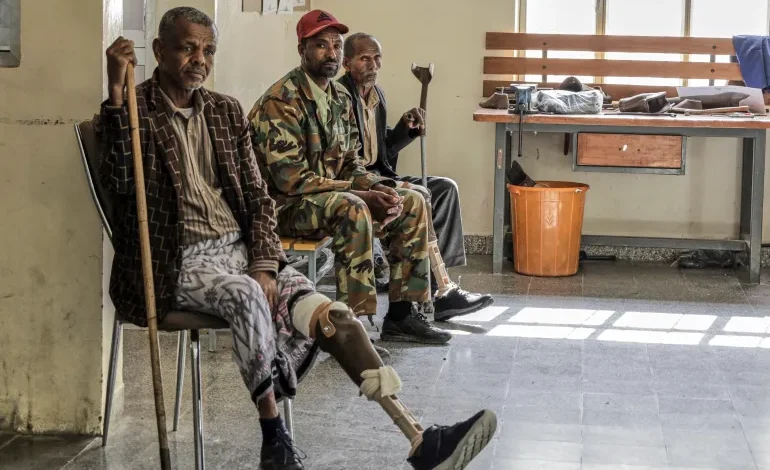
More than 80 percent of hospitals were left in ruins in Tigray during the war, according to humanitarian organisations, while sexual violence that defined the two-year conflict is still a recurring issue. Hundreds of thousands of young people are still out of school, foreign investment that created jobs in the past has in large part evaporated, and the economy remains crippled after years of war.
Meanwhile, nearly four years later, the federal government’s decision to withhold foreign funds meant for the region is deepening a humanitarian crisis. The bulk of the public service in the region, for instance, has not been paid for months.
The Ethiopia-Eritrea relationship has also deteriorated in recent years.