Far-right de la Espriella elected Colombia president: What’s next?
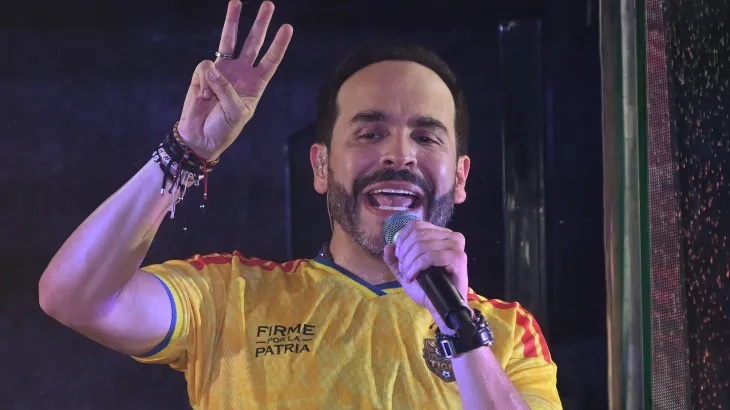
Far-right millionaire Abelardo de la Espriella, who was endorsed by United States President Donald Trump, has won Colombia’s presidential election, according to preliminary results.
De la Espriella, 47, achieved a narrow victory against his left-wing challenger, Senator Ivan Cepeda, who was backed by outgoing leftist President Gustavo Petro.
What was the election result?
De la Espriella won 49.66 percent of the vote while Cepeda trailed him by about 250,000 votes at 48.7 percent support, according to the national registrar’s tally of just under 100 percent of the ballots.
Cepeda, 63, had pledged to maintain the policies of Petro, a former rebel and Colombia’s first leftist president. Those policies included state pension payments for the poor, union-backed labour reforms, a moratorium on new oil projects and continued peace talks with armed groups.
More than 26.3 million of the 41.4 million eligible voters cast ballots in Sunday’s election.
De la Espriella emerged with a small advantage over Cepeda in the first round of voting on May 31, earning 43 percent of the vote compared with the senator’s 40 percent.
Cepeda told his supporters at an event in Bogota that he would await a final ballot-by-ballot check of the initial count, saying his campaign is challenging the results from about 33,000 polling stations, nearly a quarter of the total of 122,000.
“We are open to dialogue. We are willing to reach agreements as long as they are respectful, genuine and reflected in political actions that benefit the nation and preserve the historical progress we have already achieved,” Cepeda said.
A final verified count, overseen by notaries and judges, is required by Colombian law and was nearly finished late on Sunday. It was not clear yet whether the final results matched the initial count.
Security was a key concern for many de la Espriella voters, especially in regions where extortion and drug trafficking have risen recently.
But many Cepeda supporters feared de la Espriella’s hardline stance against armed groups could return the country to a more active conflict. For more than 60 years, the Latin American nation has been a battleground for leftist rebels, drug cartels and criminal gangs founded by former right-wing paramilitaries.
“De la Espriella’s victory marks a dramatic ideological reversal. Just four years after Colombia elected its first ever left-wing president, the country has swung hard to the right, joining a regional wave of outsider, strongman politics alongside Milei, [El Salvador President Nayib] Bukele and Trump,” Annette Idler, an associate professor in global security at the University of Oxford’s Blavatnik School of Government, told Al Jazeera.
“But the result also lays bare just how deeply polarised Colombia is. He won by less than 1 percentage point, blank and null votes alone outnumbered his margin of victory and more than half the country did not support him. This is not a mandate for radical change. It is a portrait of a nation almost exactly divided.”
Who is the new president of Colombia?
If the final results are consistent with the preliminary results, de la Espriella, a lawyer and businessman with no prior political experience, will become the new president of Colombia.
He has presented himself as a businessman, but an investigation by the online newspaper La Silla Vacia found that many of his businesses have been dissolved, are in debt and have lost money. His law firm is his most profitable endeavour, it reported. He is also a citizen of the US and Italy and has homes in multiple countries.
De la Espriella has blamed Petro for Colombia’s economic and security troubles, including a rise in violence linked to armed groups, and has pledged to end talks with rebels and criminal groups. He has also promised to boost the oil and gas sector, lower taxes and reduce the size of the state by up to 40 percent. He has said, however, that he will preserve Petro’s 23 percent increase in the minimum wage along with other popular social measures.
De la Espriella also contested the election on the promise that if he won, he would launch intense military operations for 90 days against armed groups in the country. Inspired by Bukele’s aggressive policies against drug gangs, he has pledged to build mega-prisons.
“I will govern for all Colombians, for those who voted for me and for those who chose the other candidate,” de la Espriella told a crowd of supporters in the coastal city of Barranquilla, promising to respect all citizens’ rights.
“De la Espriella benefitted from widespread disillusionment with the Petro government, which leaves office with serious unresolved crises in security, public finances and healthcare,” Idler said.
Idler explained that this public sentiment was combined with an effective media campaign that deployed AI content, influencer networks and mass rallies that Cepeda could not match.
“His antiestablishment persona, his Trump endorsement and his promise of a tough 90-day security crackdown tapped into a real public appetite for decisive action, even if his coalition of traditional right-wing voters, Petro-sceptics and protest voters remains fragile and his governing mandate far from clear.”What’s next?
The closeness of the race will likely force de la Espriella, who is to take office on August 7, to water down some of his proposals to get support from a divided Congress. Cepeda’s Historic Pact party has more seats than any other party in both the Senate and the Chamber of Representatives although no party has a majority.
De la Espriella will also have to deal with the country’s high public debt. It is about 60 percent of Colombia’s gross domestic product (GDP). Analysts and ratings agencies said weak revenue and high spending will make it difficult for the government to meet its fiscal deficit target of 5.3 percent of GDP this year.
De la Espriella’s win follows a pattern of a rightward shift in South American countries. Voters in Chile, Argentina, Costa Rica, Bolivia and Ecuador have elected right-wing presidents in their most recent elections.
“The immediate question is whether the result will be formally confirmed,” Idler explained.