‘Environmental disaster’: Ukrainian attacks on oil refineries rock Russia
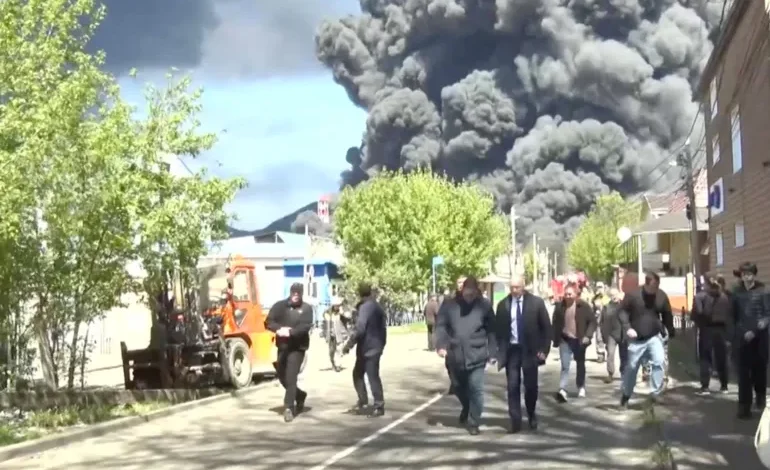
When cleanup volunteer Sergei Solovev arrived in the town of Tuapse, on Russia’s Black Sea coast, an unpleasant odour hung in the air and everything was coated in a layer of black grime.
Black rain is an unnatural weather phenomenon, where water droplets blackened by soot and ash fall from the sky. It was seen in Hiroshima, Japan, after the atomic bomb explosion in 1945, more recently in the Iranian capital, Tehran, and in 1991 in Kuwait, when oilfields were set ablaze during the Gulf War.
And now, it is falling on parts of Russia.
Over the past couple of weeks, Tuapse has been hit by a series of three Ukrainian drone strikes targeting its refinery, one of the largest in Russia. The attacks, aimed at hurting Russia’s oil industry, have caused an ecological disaster in a war that has devastated the environment.
The first strike came on April 16, causing a fire that lasted two days. Four days later, on April 20, the refinery was struck again, leaving a massive plume of thick smoke billowing into the sky. This time, the fire lasted for five days. Smoke from the fire released poisonous chemicals, and a subsequent analysis of the air around the town found that concentrations of benzene, xylene, and soot were three times above safe levels.
No more data was published after that, but residents were advised to stay indoors, keep their windows shut, and leave home wearing a mask.
Meanwhile, a black rain began to fall.
“The rain covered all the cars and animals,” said Elena Lugovenko, a local volunteer. “All the animals are covered in oil. Volunteers have set up animal cleanup centres.”
Volunteers collected distressed animals, including cats, dogs and birds, to wash away the muck before sending them to shelters. Oil spills are particularly dangerous for birds, which find it extremely difficult, if not impossible, to fly. It is also poisonous, and the feathered creatures might accidentally swallow it as they try to preen themselves loose.
By the end of the April 20 attack, at least eight storage tanks at the refinery lay destroyed, the spilled petroleum leaking into the nearby Tuapse River from where the current carried it into the Black Sea, spreading along the coast.
Authorities dispatched more than a dozen boats to clean up the slick at sea, while booms have been installed on beaches to contain the spill. Emergency crews and volunteers are working to clear the stony beaches using excavators, and the oil is being collected in barrels and plastic bags.
“It’s an environmental disaster,” said Solovev, who drove from Sochi, 116km (70 miles) down the coast, to join the effort.
“There’s oil already all over the coastline within a 20-kilometre (12-mile) radius. It’s all still not being cleaned up; it’s all covered in oil. All the soil needs to be removed, a huge amount of this muck, all covered in rocks in hard-to-reach places, which you can’t even get to with equipment.”
Whether saving the animals or mopping up the beaches, volunteering in Tuapse is hazardous work. The tiny oil droplets in the air are dangerous when inhaled, and it is imperative to apply eyedrops the second a burning sensation is felt.
“You have to drink absorbents every two hours while cleaning it up,” warned Solovev. “Wear a mask and chemical protection.”
‘Could last for years’
Local environmentalists told the independent Russian media outlet Important Stories that, in some cases, authorities covered beaches with new pebbles, hiding the mess rather than removing it.
But even if the coastal containment is successful, Ruslan Khvostov, chairman of the Green Alternative party, warned that the long-term consequences for the local ecosystem “could be serious and last for years”.
“Oil products settle in the bottom sediments of the Black Sea, disrupting the food chain, and everyone will suffer,” Khvostov told Al Jazeera.
“The oil slick blocks oxygen, causing mass mortality of fish, shellfish, and bottom dwellers; biodiversity restoration will take five to 10 years or longer, as in the case of the 2024 Kerch spill. Toxins accumulate in organisms, threatening birds and marine mammals, [such as] dolphins, bottlenose dolphins.”