Energy, water, bonds: What are Iran’s targets if Trump hits power plants?
United States President Donald Trump has ordered the Department of Defense, which the Trump administration calls the “Department of War”, to pause attacks on Iran’s power infrastructure for five days, he said on Monday.
The US president’s order came the day after he issued a 48-hour ultimatum to Iran to reopen the critical shipping route through the Strait of Hormuz or risk US attacks on its power plants. In response, Iran said it would attack power plants in Israel and the Gulf.
Trump’s ultimatum over Hormuz had been set to expire at 23:44 GMT on Monday.
In a Truth Social post on Monday, however, Trump claimed that Washington and Tehran had had “very good and productive conversations regarding a complete and total resolution of our hostilities in the Middle East”.
However, Iranian officials have denied this. Following Trump’s ultimatum over the Strait of Hormuz, Iran’s Tasnim news agency, citing an Iranian official, reported that the strait will not return to prewar conditions and energy markets will remain unsettled, adding that no negotiations with the US are under way.
Tehran is conducting regional dialogue, however.
Three weeks into the US-Israel war on Iran, we take a look at what Trump threatened, and how Iran’s Islamic Republic government has threatened to respond.
What did Trump forewarn?
On Saturday at 23:44 GMT, Trump wrote in a Truth Social post: “If Iran doesn’t FULLY OPEN, WITHOUT THREAT, the Strait of Hormuz, within 48 HOURS from this exact point in time, the United States of America will hit and obliterate their various POWER PLANTS, STARTING WITH THE BIGGEST ONE FIRST.”
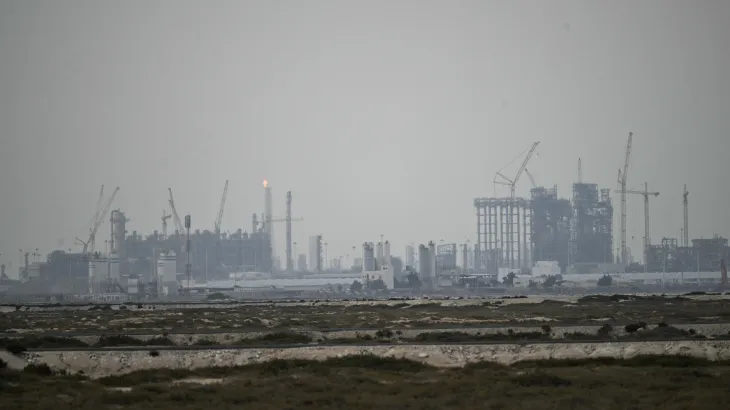
Trump did not specify which plant he was referring to as “the biggest”. However, Iran’s largest power plant is the Damavand Combined Cycle Power Plant on the outskirts of Tehran province. Also known as the Pakdasht plant, it has a capacity of about 2,900 megawatts. This is enough to meet the electricity needs of several major cities combined.
Other large power plants in Iran include the Kerman plant in the southeast of Iran, with a capacity of about 1,910 megawatts, and the Ramin power plant in the Khuzestan province with a capacity of about 1,890 megawatts. This is roughly equivalent to the electricity needs of a mid‑sized province or a large city.
On March 2, Ebrahim Jabari, a senior adviser to the commander-in-chief of Iran’s Islamic Revolutionary Guard Corps (IRGC), announced that the Strait of Hormuz – through which 20 percent of the world’s oil and gas is transported from Gulf producers – was “closed”. This has contributed to the recent surge in oil prices, which have surpassed $100 a barrel, compared with the prewar Brent crude price – the international benchmark – of about $65.
How did Iran respond to Trump’s ultimatum?
The IRGC threatened to retaliate if Iranian power plants were targeted, saying it would hit power plants in Israel as well as any supplying electricity to military bases hosting US troops and assets in the region.
Iran’s Speaker of Parliament Mohammad Bagher Ghalibaf also posted on X on Sunday: “Alongside military bases, those financial entities that finance the US military budget are legitimate targets. US treasury bonds are soaked in Iranians’ blood. Purchase them, and you purchase a strike on your HQ and assets. We monitor your portfolios. This is your final notice.”
An IRGC statement shared by state media on Monday, said: “The lying … US President has claimed that the Revolutionary Guards intends to attack the water desalination plants and cause hardship to the people of the countries in the region.”
The statement added: “We are determined to respond to any threat at the same level as it creates in terms of deterrence … If you hit electricity, we hit electricity.”
“The Strait of Hormuz will be completely closed and will not be opened until our destroyed power plants are rebuilt,” the IRGC said in a statement.
At the same time, Iranian leaders have insisted that the strait is only closed to the US and Israel.
“We have not closed the strait. In our opinion, the strait is open. It is closed only to ships belonging to our enemies, countries that attack us. For other countries, ships can pass through the strait,” Iranian Foreign Minister Abbas Araghchi told Japan’s Kyodo News late on Friday.