Can Bangladesh’s Awami League survive election ban, ex-PM Hasina’s exile?
As boatman Ripon Mridha washed his feet early in the morning after a night of fishing in Bangladesh’s mighty Padma River, his eyes scanned the walls and shutters of the shops in the neighbourhood market.
Until recently, the neighbourhood in central Bangladesh’s Rajbari district was plastered with large posters and banners, with the faces of local politicians belonging to former Prime Minister Sheikh Hasina’s Awami League party looming large.
Today, those signs are gone, leaving little traces of a party that ruled over Bangladesh for 15 years before a student-led uprising in 2024 toppled Hasina’s iron-fisted government and forced her into exile in India, her close ally.
After the uprising, Hasina’s Awami League was banned from all political activities, while a special tribunal, ironically founded by Hasina herself in 2010 to try political opponents, sentenced her to death in absentia for her role in the killing of more than 1,400 people during the protests.
On February 12, the country of 170 million people is scheduled to vote in its first parliamentary election since Hasina’s ouster.
Mridha, a lifelong Awami League voter, said he feels little enthusiasm over the election after the party he supported had been banned. He might still vote, but faces a dilemma over whom to support since the Awami League’s boat symbol will not appear on the ballot.
The boatman, about 50 years of age, said that his family fears that if they don’t vote, they might be identified as Awami League supporters in a country where Hasina and her party today draw widespread anger for the decades of killings, forced disappearances, torture and political crackdowns that they oversaw.
Under Hasina’s rule, the Jamaat-e-Islami party and Bangladesh Nationalist Party (BNP) – the Awami League’s two biggest opponents – were systematically persecuted. The Jamaat was banned, some of its leaders were executed, and many others were imprisoned. Thousands of BNP leaders were arrested, including former Prime Minister Khaleda Zia, who died in December. Her son and current BNP leader Tarique Rahman lived in exile in London for 17 years before returning to Bangladesh in December.
Widespread political violence continues to trouble Bangladesh’s preparations for the elections, with leaders from the BNP, Jamaat and other parties killed in recent weeks. But now, like their counterparts from other parties, common supporters of the Awami League no longer enjoy immunity either from the anger the actions of their leaders have triggered.
“If we don’t vote, we risk being singled out,” Mridha told Al Jazeera. “So our family will go to the polling centre.”
Conversations with longtime Awami League voters in areas where the party once dominated reveal a divided mood.
While many say they will still go to polling centres, others say they may not vote at all.
Like Solaiman Mia, a rickshaw puller in Gopalganj, the Hasina family’s bastion and the hometown of her father and Bangladesh’s founder, Sheikh Mujibur Rahman, whose grave lies in the district south of Dhaka as an enduring symbol of the Awami League’s powerful grip on the region. Hasina won huge victories in Gopalganj in every election since 1991.
Mia is unequivocal that he and his family would not vote this year. “An election without the boat on the ballot is not an election,” he told Al Jazeera, a sentiment shared by many residents of Gopalganj.
‘Awami League will return’
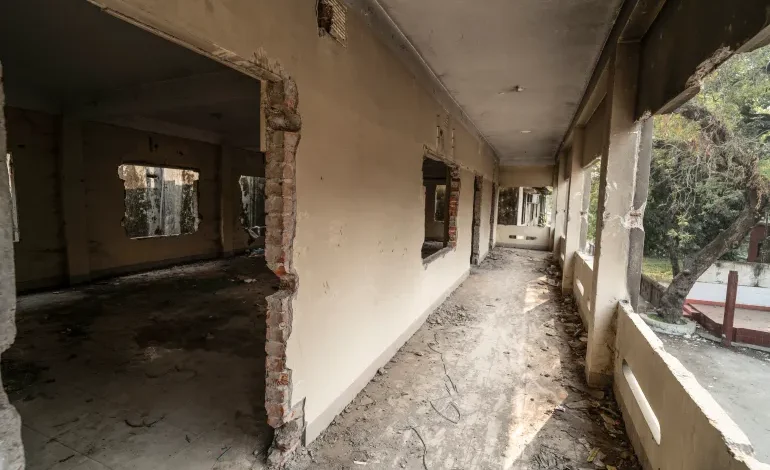
In central Dhaka’s Gulistan area lies the Awami League’s head office – now abandoned after it was vandalised and set on fire during the uprising. Since then, the building has been used as a shelter by homeless people and sections of it as a public toilet.
Outside the office, street vendor Abdul Hamid says he has not seen Awami League activists anywhere near the area for months.
“You won’t find any Awami League supporters here,” he said. “Even if someone is a supporter, they would never admit it. The Awami League has faced crises before, but it has never almost disappeared like this.”
Nearby, another street vendor, Sagor, is selling woollen scarves draped in the symbols of the BNP and its former ally and now rival, the Jamaat-e-Islami party.
“The scarves belonging to the parties are selling well,” he said as pedestrians surrounded him.
“The Awami League will return,” he told Al Jazeera. “And when it does, it will return with Sheikh Hasina.”
But Rezaul Karim Rony, a Dhaka-based political analyst and editor of Joban magazine, is not so sure. He thinks surviving the February election will be difficult for the Awami League.
“If an election takes place without the Awami League, its voters will gradually go through a form of reconciliation at the local level,” Rony told Al Jazeera. “They will be absorbed locally – aligning themselves with whichever influential forces or parties dominate their areas – and begin rebuilding their everyday lives that way.”
As a result, Rony said, it will be difficult for the Awami League to recover its support base once the election is over. He said while a section of the party’s supporters still sees no future for the party without Hasina, a sizeable group within it is frustrated by her authoritarian rule when she was in power.
“With supporters divided, with or without Hasina, returning to its previous political position is extremely difficult – almost impossible – for the Awami League,” Rony said.
‘Feels like a political wipeout’
Other analysts argue that a recent surge in support for Jamaat-e-Islami could, paradoxically, offer a reference point for a possible future revival of the Awami League. The Jamaat supported Pakistan during Bangladesh’s war of independence in 1971, a role that its critics – including Hasina – have repeatedly used to challenge its credibility.
The party was banned twice, and its top leaders were hanged and jailed during Hasina’s rule. Still, it survived, and is now – according to polls – on the cusp of its best ever performance in the February elections.
“Jamaat’s current level of activism, influence and assertiveness – what might even be described as a show of dominance – can paradoxically be seen as a kind of blessing for the Awami League,” Anu Muhammad, a retired economics professor at Jahangirnagar University, told Al Jazeera.
Muhammad said the appeal of the Awami League extends far beyond its formal political structure, making its total political erasure unlikely. “The Awami League is not just its leadership,” he said. “It is connected to cultural, social and other forces.”