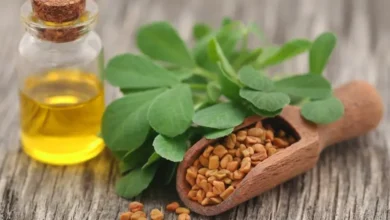
Black pepper and olive oil: The ingredients that super-charge the nutrients you get from food
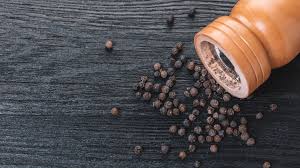
Seasoning your food or adding a dressing to a meal could help you absorb more vitamins and minerals. Scientists believe it could boost the nutrients we get from food.
It’s been a prized spice for thousands of years due to its ability to bring flavour to even the blandest of foods. Black pepper was first cultivated in India more than 3,500 years ago, where the plant that produces the spice is native; it became one of the most valuable commodities of the ancient world. Today most of us sprinkle it on our food as a seasoning, often without even thinking.
But adding black pepper to your meal might be doing more than simply adding flavour. It might be boosting the amount of nutrients you are getting from your food.
Peppercorns contain a chemical that helps vitamins and other nutrients be absorbed more easily into the bloodstream. Tiny droplets of fat found in milk and olive oil have also been found to improve the availability of nutrients to the body. Scientists are now trying to harness these effects to develop new types of fortified foods and help people who struggle to absorb the nutrients they need to stay healthy.
One of the problems we face with even the most nutrient-rich foods is whether our bodies are able to extract the vitamins and minerals as they pass through our digestive system. Take sweetcorn, for example. Sweetcorn kernels are undoubtedly packed with goodness – high in fibre, protein, vitamins and micronutrients like potassium. But anyone who has peered into the toilet bowl after a meal of corn kernels will wonder how much of that nourishment they have absorbed. The waxy outer casing of the kernel is hard for our bodies to break down, especially if we don’t chew it properly first.
“When you eat sweetcorn [without adequately chewing] it passes all the way through your gastrointestinal tract and ends up in your toilet, and all the nutrients inside are still trapped in there,” says David Julian McClements, professor of food science at the University of Massachusetts, US.
Luckily, by chewing sweetcorn, we can free the nutrient filled flesh inside so it can be digested.
What is the matrix?
This extreme example illustrates a simple fact about food – for nutrients to be digested and used by the body, they must first be released from the complex matrix of proteins, carbohydrates, fats and other components that give food its texture and structure.
There are also other barriers that can prevent vitamins from being digested. After being released from the food matrix, vitamins must be able to dissolve in the gastrointestinal fluid. They must then be carried to the small intestine, where special cells called enterocytes then carry them across into the bloodstream.
However many vitamins – including A, D, E, and K – which are classed as oil soluble vitamins – need help to be transported to their destination.
“Oil soluble vitamins don’t dissolve in water, so if you ate them and you didn’t have any fat with your food they wouldn’t dissolve, and they would just go through your gastrointestinal tract and out into poop,” says McClements.
The food matrix can help here too.
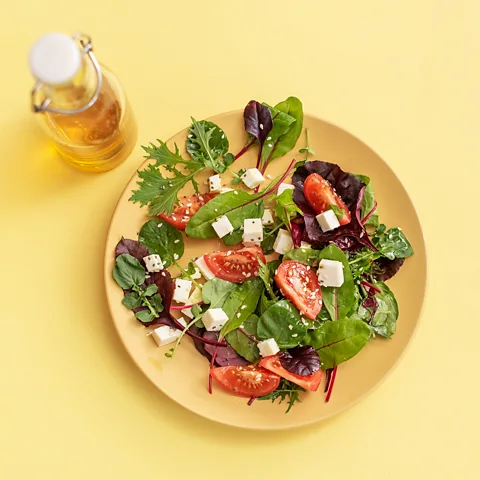
“If you eat them [vitamins] with some fat, the fat gets broken down and it forms these tiny nano-sized particles called micelles inside your gastrointestinal tract,” says McClements. “They trap the vitamins inside them. They then carry them through the watery gastrointestinal fluid into the epithelial cells where they can get absorbed.”
There are some people, however, who face additional problems with getting vitamins from their food. People with malabsorption syndrome suffer from an impaired ability to absorb nutrients due to damage to the lining of their gut. This can be caused by a variety of different reasons, including Inflammatory bowel disease, celiac disease, radiotherapy and chemotherapy. In chronic pancreatitis, patients can no longer produce the enzymes that are crucial for digesting fats, proteins and carbohydrates. Liver disease can also prevent the release of bile into the small intestine. Bile helps to digest fats, and without dietary fats, the body cannot absorb fat-soluble vitamins.
In such cases, taking vitamin supplements is often recommended.
The problem with supplements
“Vitamin and mineral supplements should not be used universally and most people do not need them,” says JoAnn Manson, professor of medicine at Harvard Medical School who has conducted large-scale studies of vitamins and supplements. Instead she says a healthy balanced diet should be enough. “However, people with Crohn’s disease, ulcerative colitis, and celiac disease are often unable to absorb fat adequately. That leads to deficiencies in fat soluble vitamins such as vitamin A, D, E and K. So taking a multivitamin in these cases could be very appropriate.”
But vitamins are less readily absorbed in supplement form. So to overcome this, scientists are devising new ways of delivering vitamins to boost absorption. The key, it seems, are nanoparticles that form spontaneously around the vitamins. “They [the scientists investigating this] are trying to simulate what the body’s already doing, but using other kinds of molecules that might not normally be found in foods,” says McClements.
Nanoparticles are incredibly small, ranging from one to 100 nanometers (nm) wide. To put this into perspective, a human hair is roughly 80,000 to 100,000 nm thick.
If we fed them salad dressing that had tiny fat droplets in, that really increased the amount of carotenoids that got absorbed – David Julian McClements
Meanwhile scientists at the University of Alberta in Canada found that encasing vitamin D within nanoparticles made from pea protein also increased absorption of the vitamin.
McClements’ own research, meanwhile, has shown that swallowing tablets of beta carotenoid – the precursor to vitamin A – with an emulsion of nano-sized fat globules, known as liposomes can boost the supplement’s “bioavailability” – the amount of vitamin that is absorbed into the blood – by 20%. Good sources of carotenoids include brightly coloured fruits and vegetables such as carrots, broccoli, leafy greens and tomatoes. In one study, McClements asked people to eat a salad either with or without the nanoparticles. The salad contained 50g of baby spinach, 50g of romaine lettuce, 70g of shredded carrots and 90g of cherry tomatoes.
“If you gave them the salad alone, very little carotenoids actually went into the bloodstream because without any fat the vitamins don’t get dissolved in your gastrointestinal fluids,” says McClements.”But then if we fed them the salad with a kind of salad dressing that had very, very tiny fat droplets in, that really increased the amount of carotenoids that got absorbed in the bloodstream.”
The power of seasoning
And this is where the black pepper comes in. When McClements and his team added black pepper to the salad and dressing, it boosted the absorption even more.
Cells in the lining of the intestine often have transporters that can kick out nutrients that have been absorbed, passing them back into the gastrointestinal tract. However a chemical in black pepper blocks these transporters, allowing more vitamin or carotenoids to be absorbed into your bloodstream.
Then McClements had a revelation – this approach had already existed for thousands of years.
“We did years of work on trying to improve the bioavailability of curcumin [a compound found in turmeric],” he says. “We compared all these different delivery systems made out of proteins or fats or carbohydrates, and it turned out the best one was these little lipid droplets that look a lot like milk that you put the curcumin in.”
“I was walking around our town, and they had this golden milk advertised. It was a really traditional, ancient Indian drink. And basically it’s exactly the same formulation that we created, but they did it 1,000 years ago.”
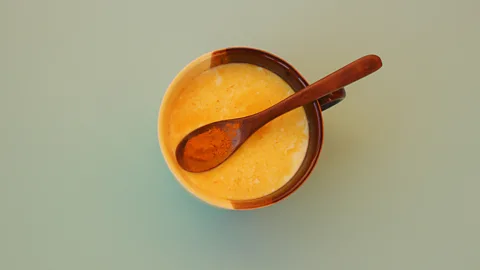
The ancient Indian drink consisted of turmeric mixed with a milk product, with added black pepper.
McClements and his colleagues have shown that high concentrations of curcumin can be loaded into cow milk and remain stable for at least two weeks if kept refrigerated. Most recently, they have also been experimenting with adding the compound to plant-based milks.
Salad dressing matters
So, fancy new vitamin formulations aside, is there anything we can all do to increase our vitamin absorption? According to McClements, if you’re going to have vitamin supplements, it’s a good idea to take them alongside a meal that has fat in it.
“Ideally you want something that contains small particles of fat, like a milk or a yoghurt,” he says.
It’s also important to note that while plants are packed with healthy vitamins, they also often contain “antinutrients” – molecules that can interfere with the body’s ability to absorb certain nutrients. For instance broccoli and Brussels sprouts contain glucosinolates, which can interfere with the absorption of iodine. Leafy green vegetables, meanwhile, are rich in compounds called oxalates which bind to calcium and stop it from being absorbed. However, as long as a variety of plants are consumed, the health benefits of such foods outweigh any potential negative nutritional effects.
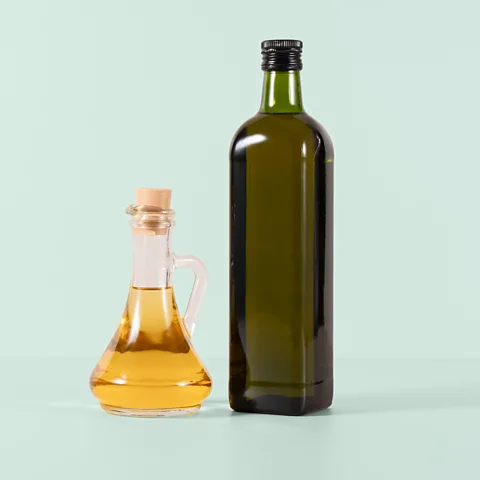
Finally, if you’re going to treat yourself to that juicy succulent salad, your choice of salad dressing or oil could make all the difference. One recent study by McClements and his colleague Ruojie Zhang at the University of Missouri revealed that pairing kale – a highly nutritious vegetable full of carotenoids, vitamins C and E – with an olive oil-based dressing can help to unlock more of those nutrients for your body.
The finding could be one of the reasons that diets high in olive oil alongside fresh fruit and vegetables, such as the Mediterranean diet, are often found to be so healthy.
“We found that nanoparticles made out of olive oil really boosted the bioavailability of carotenoids, whereas ones made out of coconut oil didn’t at all,” says McClements.
“It’s because coconut oil forms quite small micelles, and carotene is too big to fit inside them. It’s like trying to get an elephant into a Mini Cooper – sometimes you need a bigger vehicle.”