Assaulted, robbed: Refugees abused on Bosnia-Croatia border
They come from all over: Afghanistan, Egypt, Morocco, Pakistan, Syria and Sudan. But a shared goal unites them – reaching European Union soil.
For now, the refugees and migrants wait in Bihac, an unassuming town in Bosnia and Herzegovina near the Croatian border. As the EU works to overhaul its asylum system this year, their hopes of gaining refuge in Europe are being diminished.
Bosnia is not an EU member, but Croatia is.
Under the cover of the rugged woods of the Balkans, people are violently returned to Bosnia by Croatian authorities, a practice described as an illegal pushback by rights groups. According to international law, anyone arriving at a border has the right to request asylum and remain in the country while their claim is considered.
Migrants here say they are denied that opportunity, instead being forcibly sent back across the border: often bruised, stripped of their phones and winter clothing, and forced to start the journey again.
In more than a dozen testimonies to Al Jazeera, migrants spoke repeatedly of being physically assaulted and robbed by Croatian authorities.
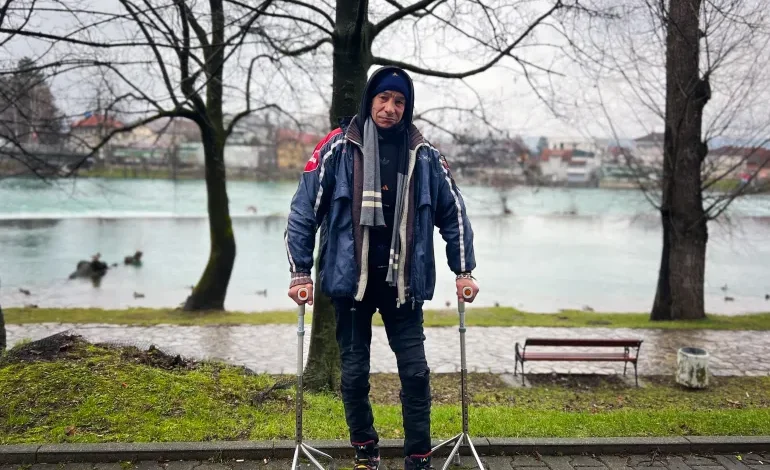
“Everyone here has a story,” says 54-year-old Hamid regretfully, his deep brown eyes watering. “People tell me my life should be a movie.”
Hamid, who is originally from Morocco, aims to reach his son Ilyas in France, but he faces a problem: his knees. Two years ago, he said Bosnian police beat him and fractured his knee, leaving him permanently disabled.
He did not want to elaborate on the details of the alleged assault, saying only that he had stepped in when he saw officers attacking another migrant.
Al Jazeera has contacted Bosnian officials but has not received a response.
Hamid has been stranded in the border town of Bihac ever since, sleeping in parks and abandoned buildings. He said he does not socialise with other migrants and prefers to spend his days alone on a park bench, given the alleged attack. He is planning his way to reach Europe. He has been trying for four years.
Perilous journeys
The journey on foot from Bosnia to Croatia is perilous, crossing icy rivers and snow-capped peaks. Most migrants are unsuccessful, attempting the crossing five or six times before landing back in Bihac. Others never make it back, drowning in the Una and Sava rivers or after encounters with Croatian authorities.
In 2025, at least 22 migrants went missing along the western Balkans route – the journey through Greece, Bulgaria, Albania, North Macedonia, Serbia and Bosnia – but this is likely a vast undercount, because the numbers depend on families back home filing missing persons reports and knowing their loved one’s last whereabouts.
In February, Abdul, a 29-year-old from Pakistan, stumbled upon the body of another Pakistani migrant in the woods when crossing into Croatia. He photographed the corpse and left it, needing to hide from Croatian guards. Three days later, he was apprehended about 100km (62 miles) past the border and forcibly returned to Bosnia.“The Croatian police held me for 24 hours and beat me. They didn’t let me use the bathroom or give me food. Then they took all my money, and they dropped me alone in the woods,” Abdul told Al Jazeera.
At the time of publishing, Croatian authorities had not responded to Al Jazeera’s request for comment.
A vocal supporter of the former Prime Minister Imran Khan, who was arrested on what many rights groups claim are trumped-up charges, he fears retribution from the new government. He spent two months crossing the rugged mountains of Iran by himself before reaching Turkiye, where he worked for a year before setting off again: walking through Bulgaria and Serbia to ultimately reach Bosnia – an increasingly common journey for Afghans and Pakistanis.
At the peak of the refugee crisis during the Syrian civil war, Bihac was crowded with Syrian migrants and refugees in limbo, unable to proceed.
As global conflicts continue to shape migration, this obscure town in the Balkans bears the weight of geopolitics: when the Taliban assumed control of Afghanistan again, the Syrians were gradually replaced by Afghans.