‘After 200 years, we’re seeing this species again’: The lost birds making a comeback in the Galapagos Islands
Freed from the threat of invasive predators, Galapagos birds are performing astonishing feats of return and innovation – 200 years after Charles Darwin visited the archipelago.
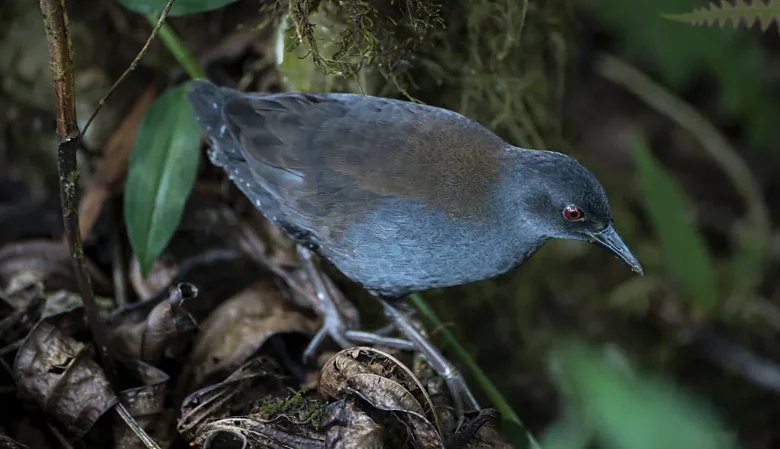
For almost 200 years, the Galapagos rail had been missing from Floreana. Thought to be extinct on this small, inhabited island in the Galapagos archipelago, the shy, near-flightless bird is still found on some of the other islands. But Charles Darwin was the last person to record a sighting of one on Floreana, when he famously visited the island in 1835.
This year, after the removal of rats and feral cats from Floreana, the bird stunned conservationists by making a surprise re-appearance on the island. How the lost bird returned is a mystery. Other threatened birds have also recovered, and some are even singing new tunes never heard on the island before, which you can listen to below. The change reveals new insights into how a safer, almost predator-free environment can allow animals to experiment and innovate, scientists say.
“The Galapagos rail was one that I was not expecting at all,” agrees Paula Castaño, a wildlife veterinarian who works for Island Conservation, one of the organisations restoring Floreana. “It just showed up” on Floreana, she says, adding that perhaps it had clung on as a small, hidden, unnoticed population all this time.
“[The rails] reappeared and now it’s very common to find these birds just walking around the island. You can hear it, you can see it, it’s unbelievable,” says Paola Sangolquí, a marine biologist at the Jocotoco Conservation Foundation, which is also part of the restoration project.
The rail’s reappearance is part of what scientists are describing as an extraordinary return of life to Floreana, after the removal of the invasive predators that had wreaked havoc on native species.
“It’s an instant explosion of these species that were considered very, very rare until last year,” says Sonia Kleindorfer, a behavioural biologist at the University of Vienna who, with her team, has been studying different finch species on Floreana and other islands for 20 years. “It’s a remarkable, instant comeback,” she adds.
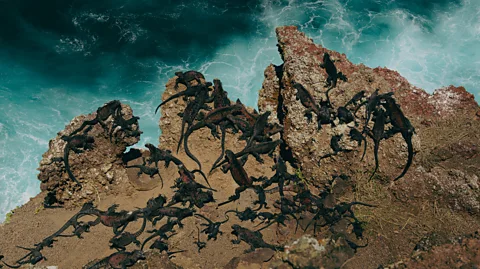
In late 2023, after a decade of preparatory work, the rats and feral cats were eradicated as part of a project to restore Floreana’s native ecosystem. In 2025, bird counts revealed that several species that were previously rare such as Galápagos doves, lava lizards, geckos and the dark-billed cuckoo were all seen more frequently, according to Birgit Fessl, principal investigator of landbird conservation at the Charles Darwin Foundation, which is part of the project to restore Floreana.
“But the most exciting finding was the re-discovery of the Galápagos Rail,” Fessl says. “This bird had not been recorded on Floreana for centuries – the only historical proof of its presence [was] a specimen collected by Darwin himself.”
Over the next few years, the plan is to re-introduce 12 species that were on Floreana when Darwin visited it, but have gone locally extinct. They include several bird species, as well as giant tortoises, and will be transferred from breeding programmes and other islands where they survived. The project is led by Galapagos National Park Directorate and carried out by Jocotoco, Island Conservation, the Charles Darwin Foundation and their partners.
Even before the re-introductions, which are expected to start next year, scientists studying Floreana are saying the island is already transforming in surprising ways, offering a rare, real-time glimpse of how ecosystems can recover. It adds to similar recovery stories seen on other parts of the archipelago, such as Pinzón Island, where the giant tortoise was on the path to extinction due to rats preying on the hatchlings – but is now seeing its numbers grow, as hatchlings are surviving.
A ‘text-book case of evolution’
“Nothing could be less inviting than the first appearance [of the Galapagos Islands],” wrote Charles Darwin about his arrival there aboard the Beagle, in September 1835. “We fancied even that the bushes smelt unpleasantly.”
Despite this unpromising start, the islands ended up hugely influencing Darwin’s most important legacy, his theory on how species evolve. The birds he recorded, more than a dozen finch species now known as Darwin’s finches, and three mockingbird species, ultimately turned out to be especially valuable clues.
“The Galapagos Islands are a beautiful, text-book case of evolution in action,” says Frank Sulloway, a science historian and adjunct professor in the department of psychology at the University of California, Berkeley, who is an expert on Charles Darwin’s life and theories.
The islands, which are closely spaced, host different species of mockingbirds, land iguanas, lava lizards and finches, Sulloway explains. Through a process known as natural selection, each species has adapted to its specific environmental conditions, which vary across the archipelago. For example, the finches – known as Darwin’s finches – have evolved from a common ancestor into species with different beaks suited to different food types. (Though it was only after returning to London, and consulting the ornithologist John Gould, that Darwin reached these insights, Sulloway says.)
Darwin also noticed that rats, mice and feral cats were already a threat to island wildlife around the world, including on the Galapagos archipelago, and described these predators as a “great plague” introduced by humans.
When a new predator is introduced, such as a rat, it changes the environment, forcing the native species in it to adapt, or go extinct, Sulloway adds. That’s what happened on the Galapagos islands, he says. “Just as Darwin envisioned, once you get the introduction of alien species, you see what was a stable system being disrupted, and then it begins to show you the principles of evolution.”
By the 2000s, invasive species had wreaked havoc across the archipelago, threatening native species and even driving some into local extinction. Between them, the rats and cats devoured baby tortoises, adult birds and nestlings, lava lizards and iguanas, and even snails. On Floreana, the Galapagos rail, the Floreana tortoise and the Floreana mockingbird were among the lost species. A 2017 survey showed that about half of the landbird species that originally lived on Floreana had gone.
“The cat and rodent eradication on Floreana began in late 2023,” says Fessl. Poison was dropped from planes and placed by hand. The researchers monitored the birds on the island before and after the operation (as a precaution, some island species were temporarily removed during the eradication). Another round of eradication targeting the remaining rats and mice is planned for late 2026.
Experimental finch songs
The return of the lost rail was not the only surprise for researchers. Perhaps most strikingly, now that the predators are gone, some of the finches on Floreana have started singing completely new songs, Kleindorfer says.
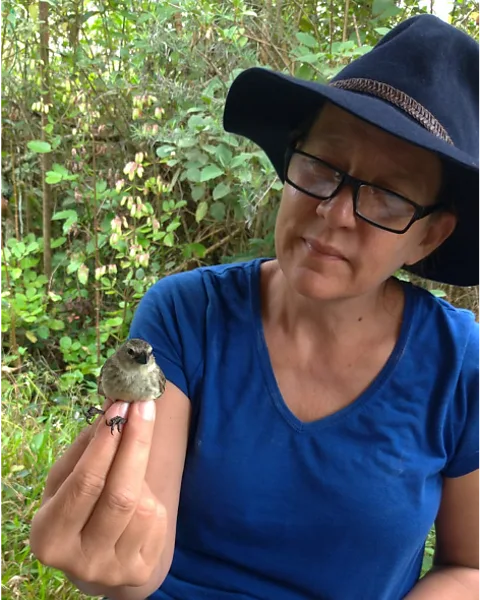
Kleindorfer and her team had been studying Darwin’s finches on Floreana and other islands in the archipelago for some 20 years, making 8,000 recordings of their songs, which all came from a narrow repertoire. There were originally nine Darwin’s Finch species on Floreana Island, she says, of which four have gone locally extinct in the last 100 years. The remaining populations on Floreana were ageing, and all sang songs from an unchanging set – such as “Chee-chee-chee-chee”, Kleindorfer says.
But this year, she was hearing young finches suddenly experiment with totally new tunes – you can listen to them in the recording below.
For example, instead of the familiar old “Chee-chee-chee-chee“, “now you get these youngsters who are like: Choo-waa! Choo-waa! Choo-waa!” she says. “Never heard that one before.”
Other young finches are skipping the syllables altogether, and picking out buzzing sounds from the old songs, turning them into new tunes:
“Some males this year, instead of producing any syllable, they’re innovating on the buzz, and they’re going: Bzz-bzz!, or Bzz-pshee!, as their song. Really weird stuff.” she says.
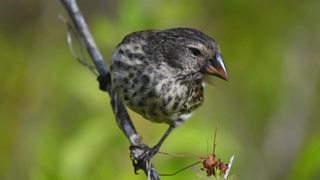
The young birds are also behaving more boldly, mingling more, and trading songs. “What we see are all these fledglings hanging out together in mixed-species flocks, and they’re learning from each other”, and imitating each others’ songs, Kleindorfer says.
What is going on?
To explain the change, Kleindorfer starts by painting a grim picture of what it was like to be a finch before the removal of the rats and cats.
“When we went to check the nests, often a rat would be looking out,” she says. “They were in the nests, climbing the trees, the island was just taken over by rats. They were even crawling on our domed tents.”
The medium tree finch was especially suffering, as its nest seemed to be at a height that suited all predators on the island, she says, including native owls. This finch species was also especially affected by an introduced parasite called the avian vampire fly, whose larvae ate the beaks of young finches from the inside, deforming their nostrils. The blood and tissue losses killed off many chicks, and the deformed nostrils prevented the finches from singing their songs properly, which ruined their chances of finding a mate.
“The finch nests were either being consumed by rats during the egg phase, [or] the chicks were eaten alive by the avian vampire fly, or the few that managed to survive – because the parents were building nests further and further away from the trunk to avoid the rats – were being picked off by the owls,” she says. “So we had very few surviving nestlings in the critically endangered medium tree finch. It was just dire.”
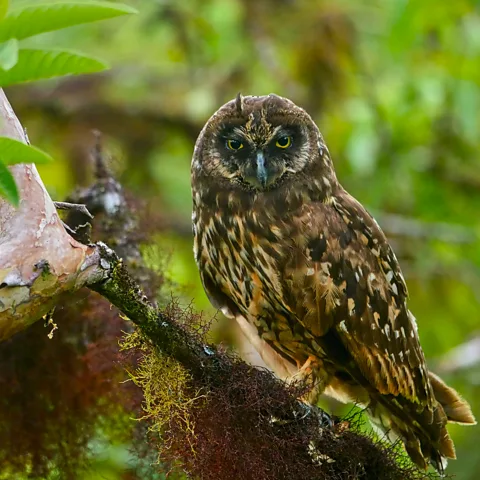
That picture has changed dramatically – to an almost predator-free one. The rats and feral cats are now mostly gone from the island. The native owls have been temporarily removed, to protect them from eating poisoned rat carcasses. The avian vampire fly is being fought by spraying nests, and offering the finches nesting material soaked in insecticide, Kleindorfer says.
As a result, monitoring data from this year shows a dramatic turnaround for the finches, according to Kleindorfer: “What did we see? Good news – we saw so much fledging success, it’s off the charts. We’ve never had so many nests produce nestlings.”
This revived younger population is experimenting with songs, due to the now safer environment, she says.
There’s a huge cost to looking and sounding different in a predator environment. When you’re freed from that, you can experiment – Sonia Kleindorfer
Finches learn one mating song when they are young, then sing it their whole life, she says. The song is learned from an older male bird, though the young bird can choose to change the tune, for example, by trying out a new sound, or imitating the sound of another species. Depending on the environment, it may either be an advantage to conform, and sound like all the others in the group – or to experiment, and sound different, says Kleindorfer.
“If you’re all singing the same song type, ‘chee-chee-chee-chee‘, and an owl is flying by, it would be hard to isolate one,” Kleindorfer says.
“Now imagine everyone going: ‘chee-chee-chee-chee‘, and one going: ‘twee! twee!‘. You [as an owl] could triangulate on the one that’s different much more easily,” and catch it, she says.
When predators roamed the island, the finches tended to all sing the same songs from a narrow repertoire of about five to 10 songs per species, she says, which essentially helped them hide in the crowd.
“There’s a huge cost to looking different and sounding different in a predator environment,” says Kleindorfer. “But when you’re freed from that, suddenly, you can experiment.”

“Now, in a safe environment, we’re having a cultural revolution,” Kleindorfer suggests, as the finches show bolder behaviour and break out in more experimental songs. “All the youngsters that are bold, they now don’t die. Before, they died,” she explains.
There is evidence from other places of a similar pattern: an Australian study on robins found that those in a predator-free environment were significantly bolder than those who lived with predators.
“I’m expecting a surge in innovation” among the finches over the next few years, says Kleindorfer, as they continue adapting to this safer environment. The next question will be how the female finches respond to the changes – and whether they favour mates with more experimental, or more traditional behaviour.
“Which [types of behaviour] are going to go extinct, and which ones are going to flourish, in ways which we perhaps haven’t imagined?” she wonders. The answer could grant entirely new insights into how, and why, behaviour evolves, she hopes.
For Paola Sangolquí, who grew up on Santa Cruz island in the archipelago, seeing the elusive Galapagos rail of her childhood become such a frequent sight has been a particularly special experience. “This island is showing how resilient species can be – after 200 years, you see a species again,” she says.