‘A large amount of weirdness’: The long, strange success of the Grateful Dead
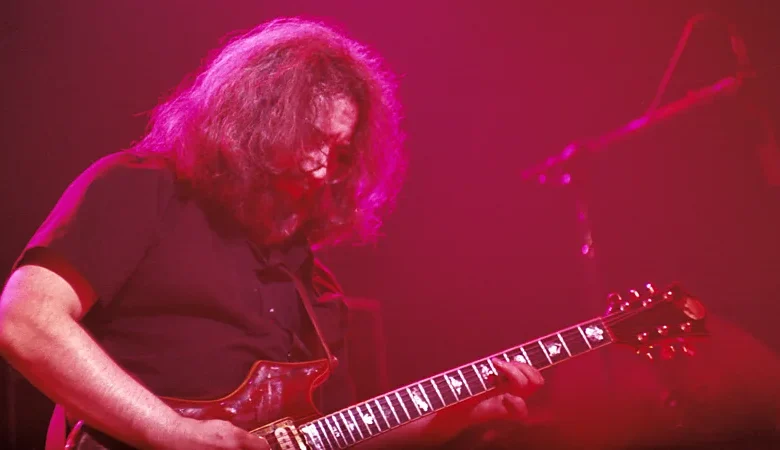
The band performed their first concert on 4 December 1965. In 1981, their leader Jerry Garcia talked to the BBC about how they became superstars but “never sold out”.
The Grateful Dead began life as kings of the 1960s West Coast psychedelic scene, yet they were untouched by glamour. Long after bad vibes and commercialism soured the hippy dream, their heady mix of lengthy improvised guitar jams and communal celebration remained defiantly unchanged, until the 1995 death of leader Jerry Garcia in rehab at the age of 53. While contemporaries such as the Rolling Stones and Jefferson Airplane adapted to shifting trends, the Dead remained essentially the same.
It was hardly a recipe for superstardom, yet when Forbes magazine listed the world’s 40 highest-paid entertainers in 1990–91, the Grateful Dead ranked 20th, with an estimated $33 million – putting them within touching distance of pop sensation MC Hammer. What a long, strange trip it had been for a band who started out three decades earlier playing in San Francisco’s Victorian ballrooms to soundtrack hallucinogenic drug experiments.
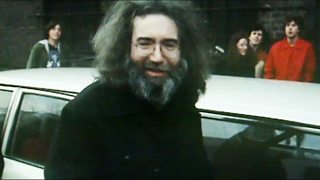
With no obvious star performer and a fiercely non-commercial ethos, the Dead were a genuine underground band. Their success wasn’t built on record sales – although in 1987 they scored an unlikely MTV hit with Touch of Grey, thanks to a video featuring life-size skeleton marionettes. Instead, they cultivated a devoted tribe of Deadheads who followed them from town to town in a travelling circus of hippiedom.
Garcia said in 1988: “To the kids today, the Grateful Dead represents America: the spirit of being able to go out and have an adventure.” Fans gathered in venue car parks long before showtime for Shakedown Street, informal markets that sprung up and were named after the band’s 1978 album. They never sold out, refusing corporate sponsorship and even encouraging the trading of bootleg tapes. They also prided themselves on ever-changing setlists, so devotees still pore over the nightly variations sparked by the band’s unique chemistry.
We would come into a town and they wouldn’t let us into the hotel, whether we had reservations or not – Jerry Garcia
In 1981, the BBC’s Newsnight was on hand to witness the excitement of the faithful at the Dead’s return to London for the first time in seven years, playing four epic nights at the Rainbow Theatre. Across the city in the Blitz nightclub, the New Romantic pop scene was in full swing, with bands such as Spandau Ballet reacting with dandyish flair to the ugly aesthetic of punk.
In History
In History is a series which uses the BBC’s unique audio and video archive to explore historical events that still resonate today.
While Grateful Dead leader Jerry Garcia – described as “now an avuncular 38” by Newsnight’s Robin Denselow – could not have stood out more from these musicians, his band had also been forged in the white-hot fires of a subcultural phenomenon. In 1967, the so-called Summer of Love had seen thousands of hippies descend on San Francisco. The small suburb of Haight-Ashbury became the global epicentre of “flower power”, and the Grateful Dead were its house band.
Garcia told Denselow that the times might have changed but the scene remained just as vital all those years later. “[Haight-Ashbury’s hippies] are still pretty much doing what they were doing then, but… the difference is now they have 15 years of experience under their belts and have gotten to be experts in what they do, just like we’ve gotten to be experts in what we do – sort of.” He said that when the Grateful Dead first started out, the US was largely unchanged from the staid 1950s era: “A lot of times we would come into a town and they wouldn’t let us into the hotel, whether we had reservations or not… As soon as they saw long hair and eccentricity of any sort, you know, that was it.”
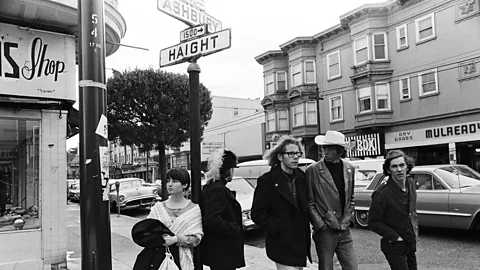
While they may have come in peace, it’s easy to see how these wild-haired hippies’ transgressive lifestyle might have alarmed the uninitiated. Indeed, the band’s formation was inextricably linked to the glorification of taking LSD. The hallucinogenic drug was discovered in 1938 by Swiss chemist Albert Hofmann. When a few years later he accidentally ingested some of the drug through his fingertips, he experienced visions of what he described as. “fantastic pictures, extraordinary shapes with intense, kaleidoscopic play of colours”. While Hofmann argued for decades that LSD could help treat mental illness, others envisaged very different applications for its potentially dangerous psychedelic properties.
The Electric Kool-Aid Acid Test
In the early days of the Cold War, the CIA created a secret programme to research mind control. Known by the code name MK-Ultra, it funded experiments on unsuspecting patients, among them people in psychiatric institutions and prison inmates, using methods including administering psychedelic drugs, sensory deprivation and electroshock treatment. In 1960, CIA-funded researchers at the Menlo Park Hospital in California were paying students $40 a day to take LSD.
One volunteer was Ken Kesey, who would later write One Flew Over the Cuckoo’s Nest. Awed by the hallucinogenic power of the still-legal drug, Kesey began to distribute it to his friends and in 1964, he assembled a string of like-minded people dubbed the Merry Pranksters and set off across the country in a brightly painted bus. The trip was chronicled by writer Tom Wolfe in his book The Electric Kool-Aid Acid Test. A year later in California, he began staging a series of parties he called Acid Tests to promote the taking of LSD. The second event on 4 December in San Jose was where the Grateful Dead played their first gig. The band had played before as The Warlocks, but it turned out that there was another group with the same name, so Garcia’s gang switched to the name by which they would be known for the next few decades.
Eight months later, the Dead first appeared – not on a music show but on the current affairs programme Panorama. In an episode titled California 2000, reporter John Morgan explored San Francisco’s psychedelic dance halls, where the “private world becomes public as strange colours and lights created out of oil, water and ketchup are bounced off walls and people”. As the band played The Mind Benders, a swirling organ-driven garage rocker, Morgan noted the aim was to “produce the circumstances of a psychiatric sensorium… new perceptions of reality created by an assault on the senses”.
Garcia was already a fixture on the San Francisco music scene, having been in both folk and blues bands, but LSD was a whole new influence. Interviewed shortly before his death in 1995, he said: “Frequently with psychedelics, I couldn’t talk to anybody. I couldn’t make myself understood or understand others, but I could communicate with music.” He described the band’s early style as “R&B with a large amount of weirdness inserted in it”. Improvision, “the first thing I learned in music”, was at its heart. “All of a sudden we could be doing a simple R&B song and it would turn into a 20-minute thing,” he said.
The band continued to attract new generations of followers, and their lengthy concerts encompassed a range of musical influences from bluegrass to jazz. For the Dead, playing live was everything. Bassist Phil Lesh said in 1993: “What the Grateful Dead has done is taken the old saw about building an audience and carried it to the absolute ultimate, because all we do is build our audience. I guess the original idea was to build an audience so we can sell records – we just built the audience and kept going back and playing to them.”
As Garcia told Newsnight: “What we’re really interested in doing is communicating to minds.” Guitarist Bob Weir added: “We learned to play our instruments better. We learn to play off of each other better. We learn to listen to each other better. And at this point, we can play more concisely. We can play more music with less notes.” After 16 years of life on the road, Garcia was as committed as ever: “It’s who we are. It’s what we do with our lives, really.”