The preacher behind the notorious 1978 Jonestown massacre
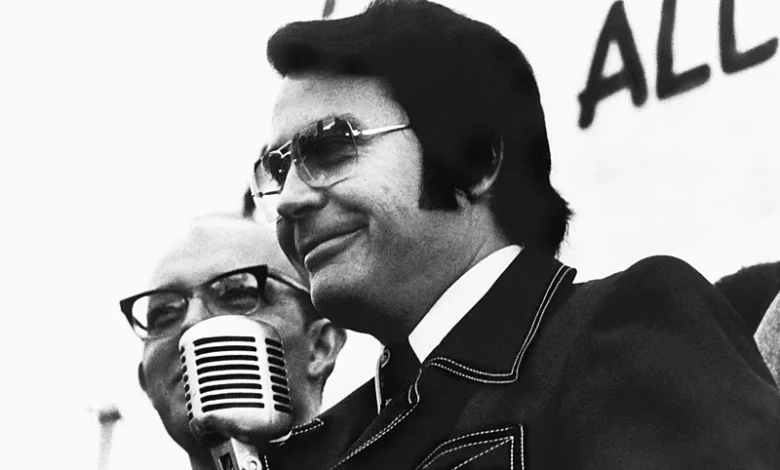
Once courted by the US’s political elite, Jim Jones caused the deaths of more than 900 of his followers. Some of those who witnessed the tragedy spoke .
“Over the summer of 1978, all of us noticed that Jim seemed to be getting sicker. His harangues over the loudspeaker were getting more and more frantic,” Laura Johnston Kohl told the makers of Jonestown: The Life and Death of Peoples Temple in 2006.
She was describing Jonestown, Guyana, where the US Christian church leader Jim Jones had decamped with 1,000 of his Peoples Temple followers the year before. Just a few months after the conspiracy-fuelled rants Johnston Kohl described, on 18 November 1978, more than 900 of these followers – over 300 of them children – lost their lives after drinking fruit punch laced with cyanide.
It became known as the biggest mass suicide in history, but as Johnston Kohl said in 2015, “It was mass murder. He completely demolished people’s will to live by telling lies.”

Born into a poor family in rural Indiana, with an alcoholic father who was a World War One veteran and suffered from lung damage caused by mustard gas, Jones set up the church group in Indianapolis in 1956. One of his adopted children, Jim Jones Jr, said in the 2006 documentary – shown in 2008 as part of its Storyville strand – that his father was a “paradox”, with “this vision to change the world, but having this whole undercurrent of dysfunction underneath that vision”.
The church group Peoples Temple was founded on socialist ideals – offering healthcare and other social services to its members – and Jones preached tolerance, community and racial equality. He quickly drew in people of different ages, races and economic backgrounds.
Jones figured out what he needed to do to manipulate each one of us – Laura Johnston Kohl
Former Peoples Temple member Deborah Layton explained the appeal in the 2006 documentary. “Every single person felt that they had a purpose… Nobody joins a cult. Nobody joins something they think is going to hurt them. You join a religious organisation, you join a political movement, and you join with people that you really like.”
Combining gospel singing, dancing and faith-healing sessions in church with messages of racial integration and social equality, Peoples Temple grew rapidly. “Jones figured out what he needed to do to manipulate each one of us into a position of being a believer. And I was a zealot. I mean, I bought it,” Johnston Kohl told Witness History.
Political power and paranoia
Attracted to California’s progressive outlook, Jones relocated his group there in 1965 – initially to Ukiah, chosen because it had been touted in the media as one of the few places in the world where people would survive a thermonuclear attack. In 1971, they moved to San Francisco. They attended demonstrations and campaigned for local politicians including the liberal mayoral candidate, George Moscone, who won by a small margin. He appointed Jones chairman of the City Housing Authority.
According to the journalist Tim Reiterman, “Jones had political power that few people, let alone preachers, could have imagined.” He was invited on board vice-presidential candidate Walter Mondale’s private jet when he came to San Francisco, and he was in contact with Rosalynn Carter during her husband Jimmy Carter’s presidential campaign.

During the 1970s, however, Jones was abusing amphetamines and barbiturates and he became increasingly paranoid. An exposé was published in August 1977 – with accounts from several people who had left the group, claiming they were beaten publicly to enforce discipline. One of the report’s writers, Marshall Kilduff, later said: “He’s… a little unhinged. He’s hard to understand or predict. This guy’s getting away with a kind of double life.” According to ex-member Layton – who wrote a book, Seductive Poison, about her experiences with the group – “what he spoke from the pulpit wasn’t what he did behind the scenes”.
Fearing repercussions after the publication of the story, Jones and his followers fled to a settlement they had been building in Guyana in South America. For many Peoples Temple members, their new rural commune, the so-called Jonestown, felt like the Promised Land, far from the problems of the US. For Jones, it provided a way to isolate his followers from their homes and their families.
But those families were vocal about their concern for relatives in the church. They prompted a Federal Communications Commission investigation of Peoples Temple, and they organised letter-writing campaigns to public officials. In November 1978, California Congressman Leo Ryan made a visit to Guyana after being contacted by concerned relatives. His aide Jackie Speier said in 2006 that there were fears Jones’s followers were being held against their will. “The word we were getting was that there was an armed encampment.”
In Jonestown, paranoia had been building for months. “Jim was corrupted by power, and when he was in Guyana, he was really in absolute control,” Johnston Kohl told Witness History. “There was no radio, no BBC, no way to bring in any kind of information. And so, he used our love of Jonestown as a way to make us paranoid ourselves about what was going on outside… he would indoctrinate us to think, ‘OK, we have all these things going, and now people are threatening to take it away’.”
Something was very, very wrong
Jones had started to broadcast ranting sermons on loudspeakers around the clock. “In Jonestown, there was a speaker system, and only Jim spoke on it, and it went 24 hours a day, and he would tape himself,” said Layton. “So in the middle of the night, all through the night, his voice was talking to you.”
“There was this pervasive sense of being under attack,” said Rebecca Moore, whose two sisters and nephew died at Jonestown. “He told them that things were just getting worse in the United States. They couldn’t go back home. And not only that, but these forces were travelling to Guyana to destroy them there.”
By the time Ryan and the journalists travelling with him arrived at Jonestown, the atmosphere was tense. Jones was setting what he called “loyalty tests”, telling his followers that someone they trusted would attempt to escape, and they needed to turn them in. “A father would turn in a son. A husband would turn in a wife. A small child would turn in a parent,” Temple member Vernon Gosney – who lost his son in the massacre – said in 2006. “There was no freedom to express to one another what was going on because everything was suspect. The most forbidden thing to express was to leave.”
On the night of Ryan’s visit, however, Gosney decided to take a chance. “I wanted to pass him a note that said, ‘Help us get out of Jonestown.'” He slipped the note to one of the reporters. According to Ryan’s aide Speier, the NBC reporter Don Harris handed them two notes from people saying they wanted to leave. “At that point we knew something was very, very wrong.”
When they returned the next day, another follower told them they were being held prisoner and wanted to go home. Ryan’s team agreed to take a few followers with them.