The heroic US lawyer who put Nazi death squad members on trial at Nuremberg
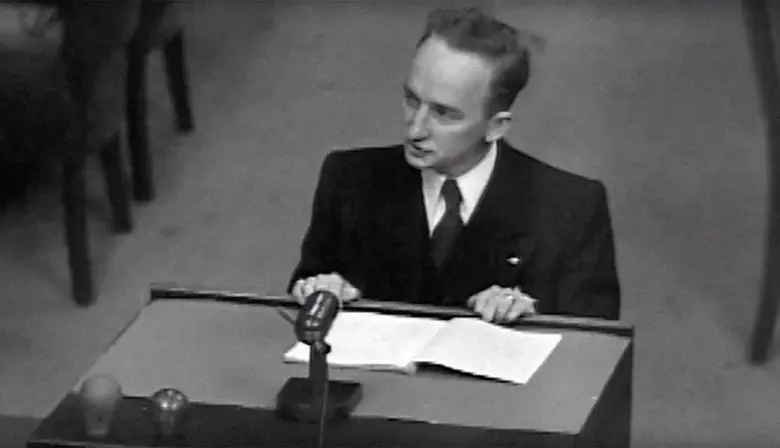
On 29 September 1947, the “biggest murder trial in history” began. Seventy years on, the chief prosecutor, Ben Ferencz, said how he fought to bring 22 killers to justice.
“I wrote somewhere that I had peered into hell – I think hell would be paradise compared to what I saw.”
In 2017, Ben Ferencz said about witnessing harrowing scenes at the Buchenwald concentration camp at the end of World War Two – an experience that led to his becoming, aged 27, the youngest US prosecutor at the war crimes trials in Nuremberg.
A Hungarian-Jewish New Yorker who signed up for the Army as soon as he graduated from Harvard Law School in 1943, Ferencz landed on the beaches at Normandy. Later, as a war crimes investigator, he was one of the first US troops to enter the newly liberated Nazi death camps. He preferred not to discuss those memories, as he told Zeinab Badawi in 2017. “I don’t like to talk about it much because I have difficulty controlling my own emotions.”

Yet even at the age of 97, he was able to recount what he’d seen in detail. “I can describe it to you quite vividly because the recollection is very firm in my mind. But at the same time, you’ll never understand what it was like because the rational human mind can’t quite grasp it.” He remembered seeing bodies on the ground as he entered Buchenwald, and prisoners so emaciated that they were “skeletons dressed in rags”.
When Ferencz returned to New York in 1945, the Pentagon (the headquarters of the US Department of Defence) asked if he could help with the trials taking place in Nuremberg. “The United States particularly felt that the International Military Tribunal against Hermann Göring was just a camera shot of a small sampling,” he said.
“And in order to really understand how a civilised country like Germany could commit and tolerate the type of atrocities which were committed, you should understand the position of the doctors who performed medical experiments, the lawyers and judges who perverted the law, the SS murderers, of course, who did the actual killings, the industrialists who were working people to death. All of these were specific groups.”
You can’t let these guys go – Ben Ferencz
Ferencz was assigned to “take a sampling from each of these groups” to help explain their actions. He flew to Berlin, where he and a team of about 50 researchers scoured the Nazi archives for evidence of the crimes committed by Germans from all walks of life.
Then his team made an unexpected discovery. “One of my researchers… came upon the daily reports from these special extermination squads whose job it was to kill, without pity or remorse, every single Jewish man, woman and child they could lay their hands on… and any other perceived or suspected opponents of the Reich.”
The researchers had found evidence of killings by what were called Einsatzgruppen, or mobile death squads that followed the German army as it occupied countries. It was estimated that up to 3,000 German men had been members of the killing units, conducting mass shooting operations in places including Poland and the Soviet Union.
Ferencz believed that Einsatzgruppen members should be put in the dock at Nuremberg, each one charged with mass murder – but he soon hit a hurdle. “No such trial had been planned. I flew down from Berlin to Nuremberg, talked to General Telford Taylor [the chief US prosecutor for the war crimes trials], and he said, ‘We can’t put on this trial now because all the lawyers are already assigned. The trials are in process. The Pentagon hasn’t approved it. I doubt if they will approve it.'”
Proof beyond any doubt
Ferencz was determined, however. “I said, ‘I have here in my hand examples of mass murder on a scale never before seen in human history. You can’t let these guys go.’ [Taylor] said, ‘Can you do it in addition to your other work?’ And I said, ‘Sure.’ And I did… It was an accident that I was a chief prosecutor.”
He explained how he selected the accused according to a set of criteria. The first was that they had to be in captivity, since “if you’ve got the evidence and you haven’t got the prisoner, you’ve got nothing”. He didn’t want to just prosecute the foot soldiers, though. “I picked those of the highest rank and then checked out their background from their Nazi Party records, which we captured in Berlin. Those who had doctor degrees or were generals, they got priority.”
These crimes are committed by well-intentioned, patriotic people – Ben Ferencz
Even then, he could prosecute only a small fraction of the perpetrators. “Of the 3,000, all of whom were complicit in mass murder… I picked out 22. Why not 28? Because we only had 22 seats in the dock. Is that absurd? Of course it’s absurd. There were only 22 seats in the dock for Herman Göring and company. So you have a selection of a sampling. That’s all it is.”
He recognised the trial’s limitations at the time. “I never anticipated or tried to do justice in the broad sense of holding every criminal accountable. It would have been a practical impossibility.”