Gaza at the Venice Biennale: Where language falls short, threads take over
I am a journalist; storytelling is my craft.
Words are the tools I turn to, again and again, to make sense of events and shape them into narratives that do them justice. And yet, when it comes to the genocide in Gaza, my birthplace, language feels wholly inadequate.
There is a limit to what words can say. At a certain point, the instinct to describe, to explain and to make sense of what has unfolded begins to break down under the sheer scale of devastation and pain.
One scene from the start of the war has lingered in my mind: A bulldozer burying 111 unidentified bodies, wrapped in bright blue bags, in a mass grave. It appeared briefly in the endless scroll of social media before it disappeared again, replaced by yet another shocking scene. And another.
A hundred and eleven souls about whom we knew nothing; not their names, not their dreams or what their final moments were. A New York Times headline read: More Than 100 Bodies Are Delivered to a Mass Grave in Southern Gaza. Omission of the perpetrator aside, could that possibly capture the magnitude of such an event?
Every attempt to describe in words what Israel has inflicted on Gaza and its people has felt reductive, compressing something vast, ongoing and staggeringly lethal into language that cannot possibly hold it. What remains is a tension at the heart of the act of telling itself; knowing no account will ever be enough, how do you tell stories of such unspeakable horrors?
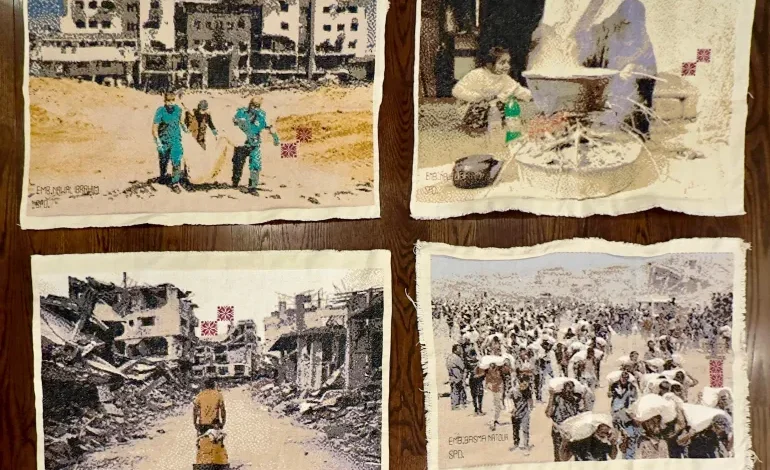
This tension lies at the heart of the Gaza Genocide Tapestry, which I am co-curating and which will be displayed at this year’s Venice Biennale. It is an art project that brings together Palestinian women in occupied Palestine and refugee camps in Lebanon and Jordan to document Gaza’s destruction in real time. They tell these stories in the way they know best: Needle and thread.
Each panel tells a fragment of what has happened: A journalist weeping over his child’s dead body; young girls with empty pots being crushed at a soup kitchen; a child crying as her world crumbles around her.
Some of these images forced themselves into the public consciousness, if only for a moment; Khalid Nabhan hugging his dead granddaughter, the “soul of his soul”, for the last time before joining her a year later, or Dr Hussam Abu Safia walking towards a tank on the orders of Israeli soldiers, to then never be seen again.
But most images from Gaza are not granted that pause. They pass without names, context or farewell.
The tapestry defies this. To embroider is to decide something is worth the effort – hours, days and weeks of labour. This is to insist it is not lost to the sheer volume of images that pass briefly before our eyes.