‘In the days of old, the world was safe’: West Bank family’s enduring unity
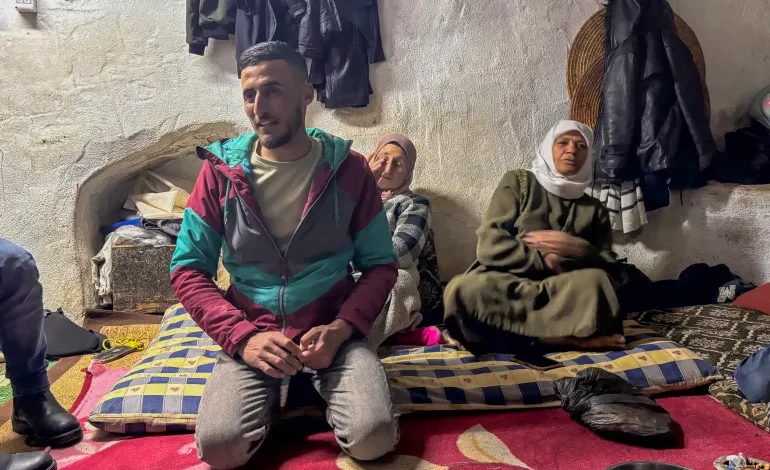
The metal door of the Masallam family home still bears the dents from a settler’s axe. Inside, the smell of freshly made cheese hangs beneath a stone-domed ceiling. Mattresses line the circular room, spread across carpets on the hard floor. Prayer beads hang from nails beside the damaged door.
On this particular evening, about 20 people are arranged in a circle — four generations of Masallams, plus relatives and a couple of friends — as young children pass small glasses of mint tea around the cosy den.
That was before her husband was killed. Before the arson. Before the kidnappings. Before the beatings and theft and loss of livelihood.
Before the Israeli settlers came.
In all, 15 people live across three single-room homes on the family compound, though relatives and friends come most evenings for tea, arghila and conversation, swelling the circle further.
The compound is bound by a stone wall, with an open courtyard at its centre where the women wash clothes, make cheese and gather by a fire at night when it is not too cold.
Nayef, 52, the stepson of Hajja Latifa, sleeps with his sons in the old stone house, built more than a century ago. Its thick walls and wooden beams support a roof of thorny brush, clay, straw and mud masonry. Beside it stand two newer tin homes: one for his eldest son, Muhammad, Muhammad’s wife Mona, and their young children; the other is where the women of the family sleep.
The Masallam compound is one of only two full households occupied year-round in all of Khirbet al-Marajim, a sparsely populated hamlet of rolling hills and an archaeological area that has been inhabited for several millennia. Al-Marajim lies a kilometre southwest of the main Palestinian town and population centre in the area, Duma, in the central West Bank, which sits on a scenic mountain ridge above the Jordan Valley.
As friends and relatives constantly cycle through the compound, no family in al-Marajim is as rooted to the land — or as visible a presence — as the Masallams, who for generations have spent their lives farming and grazing on the small hill overlooking the wadi below. The settlers know that, too. “If they manage to displace our family, they control the pastures,” said Thabet. “That’s why they focus on targeting this house. They want the entire area — and if we fall, the rest do.”
During settler attacks and military incursions, Thabet is the family’s anchor. He works the phones — calling relatives in Duma, the Palestinian liaison and Israeli solidarity activists whenever settlers or soldiers arrive. Warm and gently humorous, his can-do persistence keeps fear from overtaking the household.
But that visibility has also made him a target. Over time, a tense cat-and-mouse dynamic has developed between Thabet and the settlers and army, becoming part of the rhythm of the daily invasions.
Even under pressure, Thabet’s energy remains contagious. The women sing folk songs while making cheese in the courtyard. At night, siblings sneak moments to dance together while brushing their teeth. “Laughter and joy come naturally to us,” Thabet says one calm evening, amid the family gathering.
It always did. For as long as anyone in the family could remember, the area was peaceful.
“We would go in the night to Duma,” Hajja remembered life there decades ago. “We would stay up until 10 or 11 and go home walking, no car or anything. We would even sleep here outside, just lay out the mattress and sleep under the stars.