‘Hideous’: The controversy over Picasso’s most shocking painting
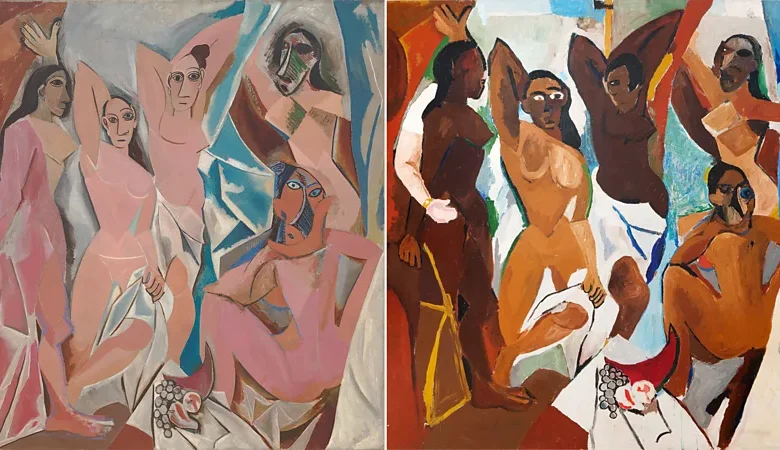
The confrontational painting Les Demoiselles d’Avignon has been both widely despised and loved, and over the decades has remained contentious. A century after it was created by Picasso, acclaimed US artist Henry Taylor reinterpreted and challenged the piece – and his version is now at the centre of a major exhibition at the Musée Picasso in Paris.
In 1907, Pablo Picasso invited a small circle of artists and friends to his studio in Paris. He wanted to show them a painting he had been working on for six months. Almost unanimously, the reaction from his peers was shock, horror and disgust. The French painter Georges Braque reportedly compared the experience to drinking petrol, and Henri Matisse is said to have called the women in it “hideous”. It wouldn’t be shown publicly until 1916, almost a decade later.
More than a century on, it has become one of Picasso’s most recognisable and controversial works. It has also been reinterpreted by the acclaimed US painter Henry Taylor. His version is currently displayed at a major exhibition at Musée National Picasso in Paris, and Taylor emphasises a key point about the earlier painting: it owes a lot more to African art than Picasso ever liked to admit.
The painting Picasso had shown his peers was Les Demoiselles d’Avignon (1907), a large oil painting in which five nude women in a brothel in Barcelona demand the viewer’s attention. Two of the women have mask-like faces, three stare back at the observer, and all have jagged, disjointed bodies. It marked a sharp turn in Picasso’s creative journey and a dramatic departure from the artistic norms of the time.
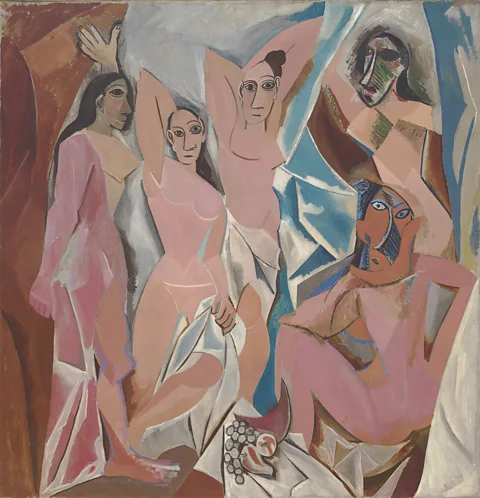
“Picasso moved away from emotional, figurative painting toward breaking forms apart and rethinking how space and bodies are shown,” Joanne Snrech, a curator at Musée National Picasso, said. “This shift was key to the development of Cubism and modern art more broadly.”
Les Demoiselles d’Avignon (The Young Ladies of Avignon) was initially named Le Bordel d’Avignon (or The Brothel of Avignon) until 1916, when the title was changed to be less contentious. It is considered a fundamental work in the birth of Cubism, the 20th-Century art movement known for abandoning traditional, realistic forms of representation in favour of fragmented and geometric shapes.
Even for artists who were already experimenting with new styles, this felt like a step too far – Joanne Snrech
As Picasso did in the Demoiselles, Cubism merged multiple vantage points of an object or person into a single image. “Part of what made the reaction so strong is that Picasso didn’t just change one thing: he changed everything at once,” Snrech says. “Even for artists who were already experimenting with new styles, this felt like a step too far.”
But Picasso’s innovations didn’t come out of nowhere. Some of them, it could be argued, came straight from the African continent.
Months before creating this painting, Picasso had developed a particular interest in African masks and sculptures, spurred by a small figurine – from what is now the Democratic Republic of the Congo – that Matisse had purchased in Paris in 1906. Picasso began regularly visiting the African section of the Musée d’Ethnographie du Trocadéro, creating hundreds of preparatory sketches for his new masterpiece.
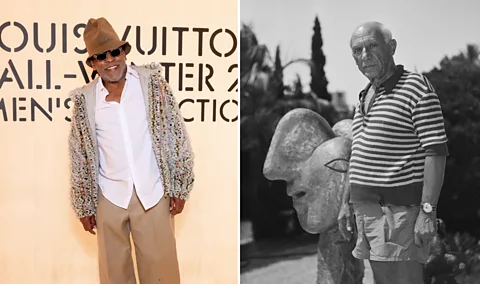
“What struck him wasn’t just how they looked, but how they worked: the faces are simplified, distorted, sometimes quite intense or even unsettling,” Snrech says. “He was clearly inspired by this different approach to the human face, which allowed him to move away from naturalism and toward something more abstract and confrontational.”
Despite this work and many others being shaped by his encounters with African art, Picasso is known to have downplayed its influence. He famously said to a critic working on a series on African art for a journal in 1920 that he had “never heard of it”. Picasso’s reluctance to acknowledge the impact of African art on his work while directly benefiting from it later provoked accusations of cultural appropriation. Critiques highlight the cultural, religious and social significance of the objects that Picasso observed but seemingly ignored, and how this fed into the wider narrative of African art being seen as “primitive” at the time.
The reimagining of Les Demoiselles
Henry Taylor returned to Picasso’s iconic painting when visiting Paris for his first European solo show in 2007, almost exactly a century after Picasso first created it. Taylor’s version, titled From Congo to the Capital and Black Again (2007), is now on show at the Musée National Picasso-Paris for Henry Taylor. Where Thoughts Provoke, his first major retrospective in Europe. He keeps the basic structure and poses of the five nude women and the two signature masked faces. But the initially white figures are now black, nodding more overtly to African art.
Henry Taylor is not just referencing Picasso, he’s questioning and reinterpreting him – Joanne Snrech
Known for exploring black life in the US, Taylor reimagines the composition from his own perspective as an artist with a different cultural and social background. “Taylor’s work often centres on people who have historically been underrepresented, giving them presence and individuality,” says Snrech. “When placed together, [Picasso and Taylor’s] works highlight not just artistic differences, but also broader questions about power, influence, and whose stories are being told.”
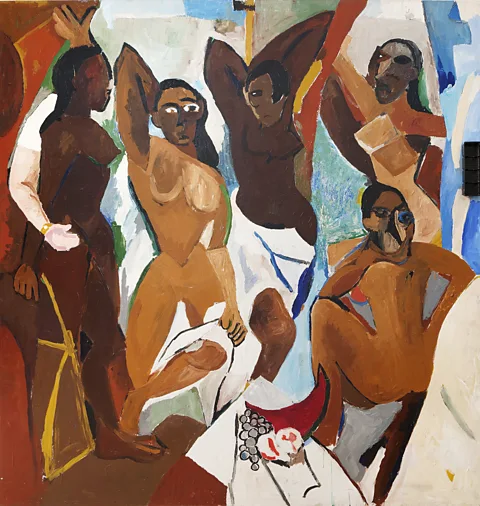
But the two works also highlight a possibly different attitude to women. Picasso’s historically troubled relationship with the opposite sex has become difficult to separate from his paintings’ afterlife. Known for a string of fraught romances, Picasso reportedly told the painter Françoise Gilot that all women are either “goddesses or doormats” and “machines for suffering”. To some critics, the violence of the fragmented bodies feels personal rather than aesthetic.
“The subject [a group of nude women in a brothel] was already provocative, but Picasso removed any softness,” says Snrech. In the newer version, while abstracted, their bodies are less disjointed – the result is more powerful than aggressive.
Taylor’s central figure stands with her arms partially behind her back. The short asymmetrical bob she wears shares a likeness with Josephine Baker, a US-French dancer and singer, known as the first black woman to become a world-famous superstar. By doing this, the artist “brings in questions of identity, race, and representation”, Snrech says.
Taylor’s title, From Congo to the Capital and Black Again (2007), references Matisse’s Congolese figure that sparked Picasso’s interest in African art, noting its movement from Africa to Paris. It also refers to the way Taylor himself made the painting “black again” by incorporating black people. Yet a white male disembodied arm with a gold watch also hovers in the far-left corner, groping one of the subjects. This could be a nod to the two men – a sailor and a medical student – Picasso initially thought about including in the painting. “He’s not just referencing Picasso, he’s questioning and reinterpreting him,” Snrech adds.
Despite Braque’s initial comment about Les Demoiselles, he himself adopted a more angular approach to his paintings soon afterwards. And by the 1920s, what initially caused disgust in Picasso’s paintings was what saw it recast as a masterpiece. The writer and poet André Breton hailed the painting as revolutionary, convincing the French fashion designer and art collector Jacques Doucet to buy it. And in 1939, New York’s Museum of Modern Art acquired it as a canonical piece. It still resides there today.
More than a century on, Les Demoiselles d’Avignon remains so contentious that artists are still grappling with the themes within it. Proof, surely, of how one painting can be both widely despised and loved at the same time – and can define a dramatic turning point in art history.