Food labels have far-reaching effects on our health

Our environment drives many of the choices we make around what we eat. Evidence shows that to encourage consumers to make healthier choices, better labelling and education are crucial.
Walk into a standard supermarket and you’ll quickly be presented with an array of unhealthy, ultra-processed options which are often too tempting to ignore.
We live in an age of abundance and the average weight of the general population in many countries continues to rise. A key contributor to weight gain has been linked to diets high in ultra-processed foods (UPFs).
What’s now increasingly being understood is that the messaging on packing itself influences what we buy and eat. Small changes to labelling can make a surprising difference to what we buy – but equipping ourselves with better knowledge about nutrition can also help us make better choices.
In fact, many leading experts say the food environment – such as the way food is produced, marketed and sold – itself is “obesogenic” (creating the conditions for weight gain) and this influences consumers to make unhealthy choices. To combat the growing levels of obesity, we need to change what we eat – and emerging research shows that behavioural interventions as well as policy change could make a meaningful difference.
The food environment
By 2050, more than half of adults in the world are predicted to be obese if current trends continue according to a 2025 Lancet paper. If action is taken now, this rapid rise can be prevented but “without immediate and effective intervention, overweight and obesity will continue to increase globally”, researchers wrote in the Lancet paper.
But when the food environment itself is part of the problem, much of which is designed to maximise profit, what can be done?
Franco Sassi, a prominent public health researcher at Imperial College London, told me that while individuals feel as though they can choose what they buy and eat, the evidence paints a different picture. “The environment is what determines what you’re going to choose. Even if you think that you are in control,” he says. This, he says, regularly leads individuals to choose unhealthy options.

How products are marketed to us and where they can be found play a key role in the choices we end up making, he adds. “Everything in our lives is really controlled by what we see in the environment that surrounds us.”
Indeed, research has consistently shown that food choices are heavily influenced by our surroundings, affordability and availability.
Better labels
What makes this particularly troubling is ultra-processed foods (UPFs) are tweaked by manufacturers to make them as irresistible as possible – and, as some increasingly point out, addictive. This is despite the increasing understanding of the link between UPFs and adverse health outcomes – even an early death.
Making this abundantly clear on food labels can and does cause behavioural change. In 2016, Chile implemented mandatory black labels on products to indicate that they were high in sugar, salt or calories. This resulted in a 23.8% decline in purchases of products high in calories.
This has already been implemented in several countries in central America, and has led to greater consumer awareness, according to FabioGomes, an advisor at the Pan American Health Organization, an international public health agency. “It’s the minimum [information] we need to provide to consumers,” he stated at a recent conference hosted by Imperial College London. Even a small resulting reduction in UPF consumption would be a benefit, he added.
Similarly in several European countries, many food products now have a front-of-pack label called a “Nutri-score”, which was first implemented in France. It consists of colour-coded letters from most from most nutritionally healthy (dark green/A) to least healthy (red/E) and was developed to help consumers make more informed choices when purchasing food, says Mathilde Touvier, director of research at the French National Institute for Health and Medical Research and co-creator of the logo. To date, 1,500 brands use the label and pressure is now increasing to make it mandatory in Europe.
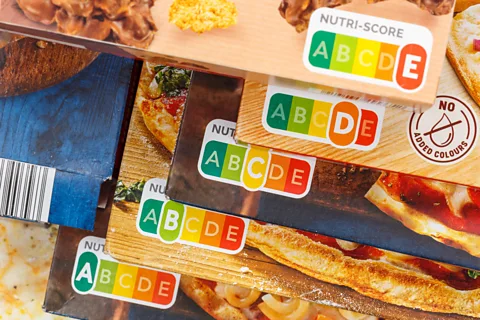
The Nutri-score came about after several large-scale studies by Touvier and colleagues showing associations between nutritional quality and adverse health outcomes, including cancer. This sparked widespread media debate, she says, leading to public perception that people “were being poisoned” by the food industry, she tells me, which in turn increased pressure on food companies to make changes.
In response some manufacturers decreased the proportion of sugar in their products and shifted from refined grains to whole-grain flours. Supermarkets also promoted healthier products, which increased sales of “Nutri-Score A” products and decreased sales of “E” (poor nutritional quality) products, says Touvier. Consequently, Nutri-Score labelling has been shown to change consumer behaviour too.
Changing behaviour
So, short of systemic change in the food environment, is there a way we can navigate it better to make healthier choices?
Research suggests that encouraging individuals to change their behaviour can change their eating habits. Research led by Samuel Dicken and Abi Fisher at University College London has recently shown that one-on-one support reduced how much UPFs the 45 study participants ate.
Individuals were given individualised one-on-one coaching, including information about where to buy healthier food and access to low-UPF meal plans. They were also given guidance on cooking from scratch.
“We know we need to improve the environment but also we need to give people skills and actions to improve their diets,” says Dicken. “It’s all well and good saying ‘cook a meal’ but if you don’t have a kitchen, if you don’t have pots and pans, if you don’t have a fridge to store it in, there’s no way you’re going to do it.”
At the end of the six-month study period, the participants reported a 25% reduction in ultra-processed food intake among participants, as well as weight loss, reduced BMI and improved wellbeing.
While this was a pilot study without a control group, the team hope to explore this further on a larger trial. The response from participants to these interventions was overwhelmingly positive too, he says.
Of course, personalised behavioural interventions are time-consuming and expensive to implement and healthy food tends to be more expensive than unhealthier options.
And to enact true change, several interventions must take place, Sassi says, because any one solution will not work in isolation. “We really need all these actions together because the [food] environment is so complex.”
And when we do so, Sassi and Touvier note that more individuals will be empowered to identify and limit high UPF diets and improve their overall health in the process.