After Iran’s salvo hit their skylines, will Gulf states enter the war?
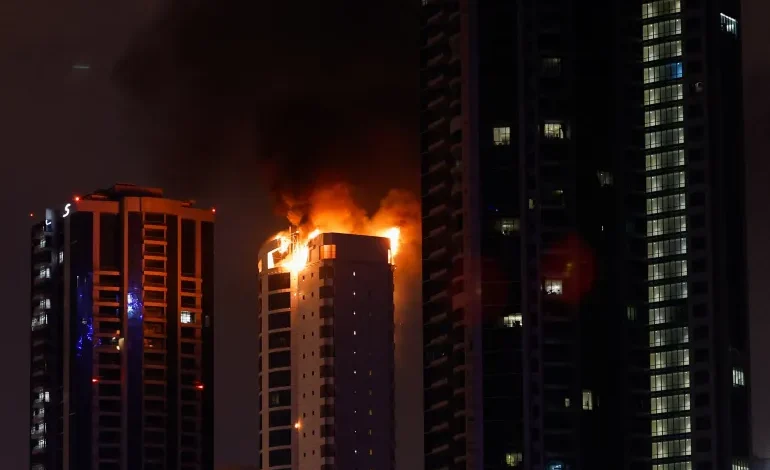
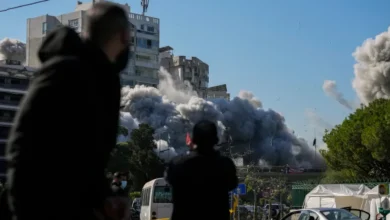
When Iranian missiles slammed into Doha, Dubai and Manama over the weekend, they shattered more than glass and concrete – they also were a blow to the Gulf states’ carefully cultivated image as oases of stability, insulated from the crises and conflicts in the rest of the Middle East.
Now, countries in the region face what analysts describe as an impossible choice: strike back and risk being seen as fighting alongside Israel, or remain passive while their cities burn.
“For people and political leaders here, seeing Manama, Doha and Dubai bombed is as strange and unimaginable as seeing Charlotte, Seattle, or Miami bombed would be for Americans,” Monica Marks, a professor of Middle East politics at New York University Abu Dhabi, told Al Jazeera.
The attacks came as Iran retaliated against a massive joint US-Israeli assault that began on Saturday. The operation killed Iran’s Supreme Leader Ayatollah Ali Khamenei and other senior military leaders, and struck military and government sites across Iran. A school was also hit, and at least 148 people were killed in that strike alone.
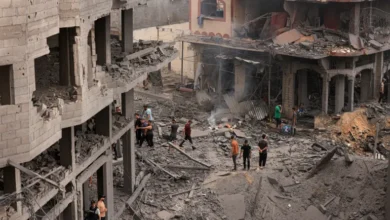
Tehran retaliated with missiles and drones targeting Israel and US military assets across the Gulf, killing at least three people in the United Arab Emirates (UAE), where at least 58 people had been injured as of Sunday evening. Either missiles — or debris after they were intercepted — hit landmark buildings and the airport in Dubai, high-rises in Manama, and Kuwait’s airport, with smoke also seen billowing from some neighbourhoods in Doha. Saudi Arabia said Iran also struck Riyadh and its eastern region. Qatar said 16 people had been injured on its soil, while five people were injured in Oman, 32 in Kuwait and four in Bahrain.
A war they tried to stop
The Gulf states did not want this confrontation. In the weeks leading up to the attack, Oman had been mediating indirect talks between Washington and Tehran, with Foreign Minister Badr Albusaidi declaring that peace was “within reach” after Iran agreed never to stockpile enriched uranium and to dramatically dilute its existing enriched uranium.
Still, hours later, the US and Israel launched missiles.
“GCC [Gulf Cooperation Council] states have seen this war coming in slow motion for weeks, if not months, and have exerted a huge amount of effort to stop it,” Marks said.
They knew, she added, that a cornered Iranian regime would “choose fratricide before suicide”, taking its Gulf neighbours hostage rather than accepting defeat.
Rob Geist Pinfold, a lecturer at King’s College London, agreed that the Gulf states had tried hard to prevent military action.
“The GCC states did not want this war. They tried to lobby against it,” he told Al Jazeera. Against that backdrop, he said, the prospect that they might join the war — and be seen as “working with the Israelis, is a huge challenge for their legitimacy”.
Yet remaining passive carries its own risks. Pinfold described the Gulf states’ predicament as a “conundrum”: doing nothing while Iran strikes repeatedly is just as damaging to their standing as entering the war.
“At the end of the day, these governments are responsive to popular opinion,” he said. “They want to be seen as protecting their people, protecting their territory and their sovereignty.”
Both analysts suggested the Gulf states may ultimately choose to act – but on their own terms.
Pinfold argued they are more likely to launch strikes themselves, possibly through a joint GCC effort like the Peninsula Shield Force (PSF), rather than simply opening their airspace for US and Israeli operations.
The PSF was a unified army created in 1984 by the GCC, which evolved into the Unified Military Command in 2013.
“They don’t want to be seen as working for Israel or working with Israel,” he said. “They want to be seen as leading, not just following.”
This would allow the Gulf states to “get in the driving seat” and demonstrate agency after weeks of being sidelined, Pinfold added.
“It’s been the US and Israel that started this war. It was Iran that escalated it. So now the Gulf states are in a position where they can show that they are not just passive – they’re not just the people being bombed.”
Nightmare scenarios
The immediate fear for Gulf leaders centres on their most vulnerable infrastructure. Marks identified what she called the “real nightmare scenario”: Strikes on power grids, water desalination plants and energy infrastructure.
“Without air conditioning and water desalination, the scorching hot and bone-dry Gulf countries are essentially uninhabitable,” she said.
“Without energy infrastructure, they’re unprofitable. Gulf states will take whatever steps they deem will least jeopardise those interests.”