Deadly tower collapse has locals in Lebanon’s Tripoli asking: Are we next?
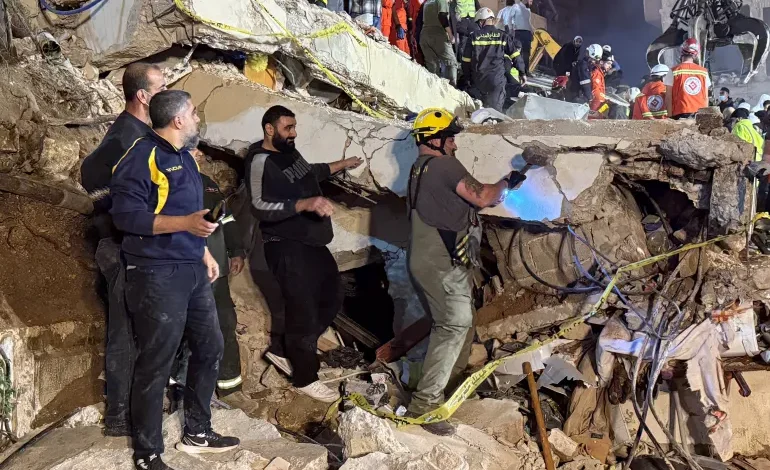
A few metres away lies a pile of smashed concrete blocks and twisted metal. It is the rubble of a building that collapsed on February 8, killing at least 15 people.
In Tripoli, collapsed buildings are fast becoming common. This is the fourth building to collapse this winter alone. Today, hundreds of buildings are at risk of collapse due to a lethal combination of ageing infrastructure, unregulated construction, Lebanon’s 2019 economic crisis, the 2023 earthquake that fractured much of the local infrastructure’s foundation, and a relatively heavy rain season.
Locals like Hazrouni are afraid their buildings will be next.
“They told us that you should evacuate and you shouldn’t stay, but how are we supposed to leave when we are in a bad situation?” he asked, raising his palms to the sky. “Where are we supposed to go?”
Collapsing structures
In the 1950s, Tripoli, Lebanon’s second-largest city and the largest in the country’s north, was a hub for trade and shipping in the region. But in the intervening years, its status has fallen to become one of the poorest cities on the Mediterranean Sea.
It is also a city of massive disparity. Multiple billionaires live in Tripoli, including the former Prime Minister Najib Mikati and former Minister of Finance Mohammad Safadi, while about 45 percent of the city’s population lives in poverty, according to a 2024 World Bank report.
Over the years, most of Tripoli’s middle- and upper-class residents have moved to the southern edge of the city, leaving behind its impoverished classes to inhabit the decaying old city. Many of the poor know their concrete buildings are ageing and in poor condition, but have little means to fix them.
“The first problem is that the structures are old,” Fayssal al-Baccar, an engineer, told Al Jazeera from a restaurant in southern Tripoli. Al-Baccar is also the founder of the Tripoli Emergency Fund, a private initiative started in response to the collapsing building issue that has been fundraising to help the city.
“The lifespan of concrete is between 50 to 80 years,” al-Baccar explained, and in many of the buildings in central Tripoli, that lifespan is coming to an end. On a sheet of white paper with a blue pen, he drew a model of a building’s foundation.
“Through time, the pH [level] of the concrete will become more and more acidic,” he said, sketching lines around the base of his drawn wall. “Then it will corrode the steel – the steel will self-destruct – and the building will collapse.”
The issue has been exacerbated by a few incidents in particular. When a 2023 earthquake devastated northern Syria and southern Turkiye, it was widely felt in Tripoli as well. Local officials say that it damaged much of the infrastructural foundations of older buildings, many of which have had irregular or unregulated floors added to them, making them weaker. The area has also suffered from neglect and a lack of infrastructure for years, even before the 2019 economic and banking crisis.
Lastly, there is the issue of water damage. This year, Lebanon has received more rainfall than in the last couple of years. And in the days leading up to the collapsed building on February 8, it rained multiple times. “Water is infiltrating into the concrete and is also making the steel worse,” al-Baccar said.
That is why al-Baccar has recruited whom he described as some of the city’s “best and most successful” to help fill governmental gaps.
One of those people is Sarah al-Charif, the Tripoli Emergency Fund’s spokesperson and fundraising committee member. She is also the Lebanon director for Ruwwad Al Tanmeya, a nonprofit focused on youth and disenfranchised communities, and was appointed vice president of Tripoli’s Port Authority last year.
“You’re talking about areas where most, if not all, of the buildings are old and dilapidated, some of which are actually on the verge of collapse,” al-Charif said from her office at Ruwwad Al Tanmeya’s office in Bab al-Tabbaneh, less than a kilometre (0.62 miles) away from where the building collapsed on February 8.