Visualising AI spending: How does it compare with history’s mega projects?
World leaders and tech executives are convening in New Delhi for the India-AI Impact Summit 2026, focusing on the role of artificial intelligence in governance, job disruption and global collaboration.
However, behind these discussions lies the financial reality. Over the past decade, AI has drawn one of the largest waves of private investment in modern history, totalling trillions of dollars.
According to Gartner, a United States-based business and technology insights company, worldwide spending on AI is forecast to total $2.5 trillion in 2026, a 44 percent increase over 2025.
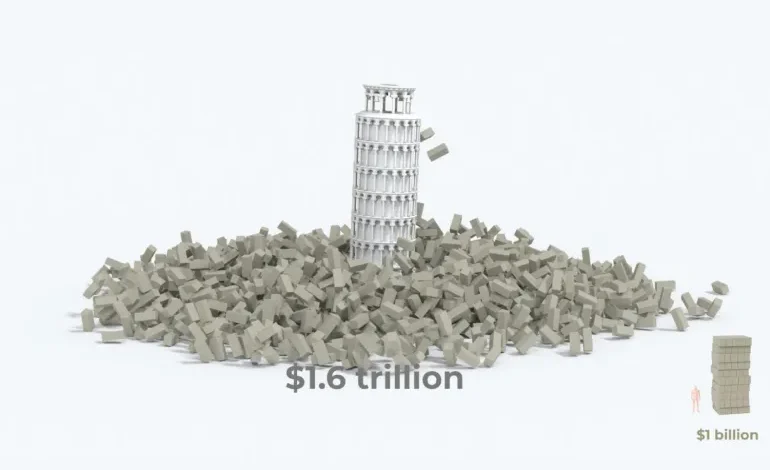
To understand the magnitude of these investments, Al Jazeera visualises the staggering amounts by comparing them with some of the largest projects ever created by humanity. We also highlight which countries are spending the most on AI and provide insights into expenditures on data centres, models, services, and security.
What does $1bn look like?
To help understand a trillion dollars, it is useful to first visualise what millions and billions of dollars look like by using a stack of US dollar bills.
If you break these amounts down using $100 bills, here is how they stack up:
$1,000 would form a stack about 1cm (0.393-inch) high.
$10,000 would form a stack approximately 10cm (3.93-inch) high.
$1m would fit inside a briefcase.
$10m would fit inside a very large suitcase.
$100m would fit on an industrial pallet stacked waist-high.
$1bn would create a building approximately 5.2 metres (17 feet) high, with a width and a length of about 2 metres (6.6 feet) each.
In just over a decade, investment in AI has surpassed the cost of developing the first atomic bomb, landing humans on the moon and the decades-long effort to build the 75,440km (46,876-mile) US interstate highway network.
Unlike these landmark projects, AI funding has not been driven by a single government or wartime urgency. It has flowed through private markets, venture capital, corporate research and development, and global investors, making it one of the largest privately financed technological waves in history.
Global corporate investments in AI cover a vast array of operations, including mergers and acquisitions, minority stakes, private investments, and public offerings. These monumental expenditures highlight the extensive financial commitment to advance AI.
Which countries are spending the most on AI?
The AI investment surge is concentrated in just a few countries, where private capital has fuelled thousands of startups and shaped global innovation hubs.
The US has dominated AI spending, accounting for roughly 62 percent of total private AI funding since 2013. Between 2013 and 2024, US companies spent $471bn on AI. Chinese companies are the second-largest spenders at $119bn, followed by the United Kingdom at $28bn.
These figures exclude government spending, such as the US CHIPS Act or European national AI subsidies.