Fungi mining and giant waste piles: How to get rare earths without mining rock
As nations posture over access to rare earth deposits, scientists say these coveted materials are hiding in plain sight – and can be harvested without any conventional mining at all.
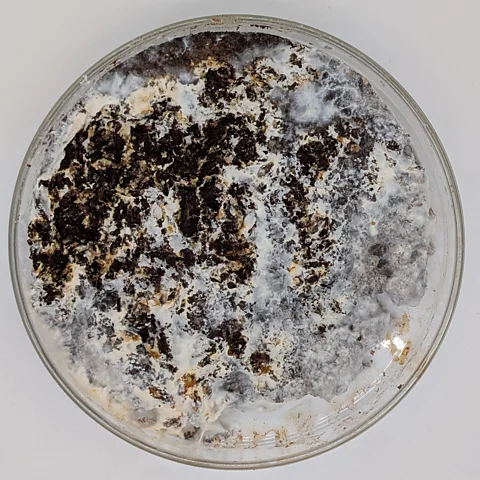
In a lab in Austria, two scientists are watching a fungus grow. Developing fungi form sprawling microscopic networks called mycelia, inserting themselves into nooks and crannies all around. Searching, spreading, feeding. It’s through the mycelium’s millions of tiny, root-like strands that the fungus draws up nutrients. But some fungi soak up other things, too. Things that humans want.
The lab fungus, at the University of Vienna, is growing in a petri dish and some clear plastic bags, across a special clay that has been purposely laced with rare earth elements. These sought-after elements are used in batteries, magnets, renewable energy devices and other tech. The scientists want to see whether the fungus can extract the rare earths for them. “You might be able, actually, to recover resources,” says Alexander Bismarck, head of the polymer and composite engineering group at the institution.
Rare earths are a group of 17 metallic elements, all chemically very similar to one another. They include dysprosium, yttrium and scandium, to name a few. Despite the name “rare earths”, they’re not actually very rare but scattered almost everywhere around the Earth. It’s just that these elements tend to be in fairly low concentrations in most places, which makes extracting a high volume of them difficult.
Given the usefulness of rare earths, interest in them is growing. US President Donald Trump, for one, says the US will spend $12bn (£8.8bn) on creating a “strategic reserve” of rare earths, and lately he has bullishly sought access to rare earth deposits in Ukraine and Greenland. Currently, China dominates the rare earths industry, with roughly 70% of rare earths mining and 90% of processing occurring within the country.
Researchers around the world are working on new ways of obtaining these elements – from harnessing the power of fungi, to developing techniques for separating rare earths out from gigantic piles of industrial waste. All developed economies require rare earths to some extent and it might actually be possible for many countries, including the US, to harvest more of the rare earths they need at home, reducing or perhaps even eliminating the need to tussle for these elements internationally.
If we look at waste with fresh eyes we see a different picture in terms of scarcity and abundance – Julie Klinger
It takes several weeks for the fungus in the University of Vienna lab to grow, says Bismarck. He and his colleague Mitchell Jones, a materials scientist, envisage using fungi on a much larger scale one day, for example to recover rare earths from land that has been contaminated by industry. “We really could do this over large areas and quite easily collect that biomass using existing agricultural machinery,” says Jones, though he admits that’s a long way off. “This is all a little bit speculative.”
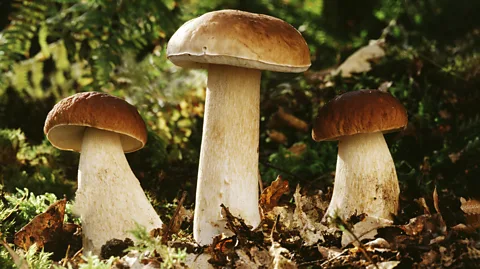
Fundamentally, though, it is an attempt to repurpose fungi. While fungi play important roles in ecosystems, they can also cause illnesses or other problems – including contamination of containers and samples in labs. Getting a fungus to work for you might be a good idea, though, because these organisms are tough and can survive in the dark. They also grow much faster than most plants, which could make them a particularly good choice for cleaning up industrial sites. It’s a process called bioremediation but, in this case, it would also involve recovery of useful minerals. Bismarck and Jones call it “mycomining”. They published a paper in 2024 describing the concept.
Once harvested, the fungi could be processed to produce biogas, and burned as a fuel, with the rare earths later separated from the ash produced. Bismarck and Jones stress that this way of recovering rare earths might only ever be “supplemental”. For example, the concentration of cerium in dissolved e-waste (old computers and other tech) could be nearly 5,500 parts per billion – but in fungi, the concentration of cerium might only reach roughly 350 parts per billion. Plus, there could be environmental risks associated with growing fungi on a large scale. “Are you actually altering the natural biome there, and is that OK or not?” says Jones.
He and Bismarck are not the only ones working with fungi, though. Oona Snoeyenbos-West at the University of Arizona says she plans to launch a start-up company that will explore using fungi for bioremediation and bio-recovery of critical minerals, especially rare earths and copper. She says the fungi could be sourced from industrial and contaminated sites because such fungi might already be genetically adapted to soak up relatively high concentrations of rare earths.
Novel approaches to rare earth extraction are worth exploring, says Julie Klinger, an associate professor in environmental studies at the University of Wisconsin-Madison, and author of Rare Earth Frontiers. “Figuring out how to get the materials we need without digging holes in the ground, I think, is really the way we need to be going,” she says. Klinger points to a study published in 2025, which described how lots of critical minerals required by US industries, including rare earths, are actually already present in piles of waste littering the US. “If we look at waste with fresh eyes, we see a different picture in terms of scarcity and abundance,” says Klinger.
Around 15 years ago, French firm Rhodia announced it had developed a process for extracting rare earths from disused fluorescent light bulbs. Rhodia was subsequently purchased a company called Solvay. A spokeswoman for Solvay says the firm no longer extracts rare earths from these bulbs because, with the adoption of LED lighting, there are now far fewer fluorescent bulbs being thrown away than there were before.
There is plenty of other waste around. Leftover materials from mining, called tailings, can be rare earth hotspots, including the tailings at the Mountain Pass Rare Earth Mine in California. Klinger suggests that these tailings themselves could be processed in order to obtain the residual rare earths that remain within them.
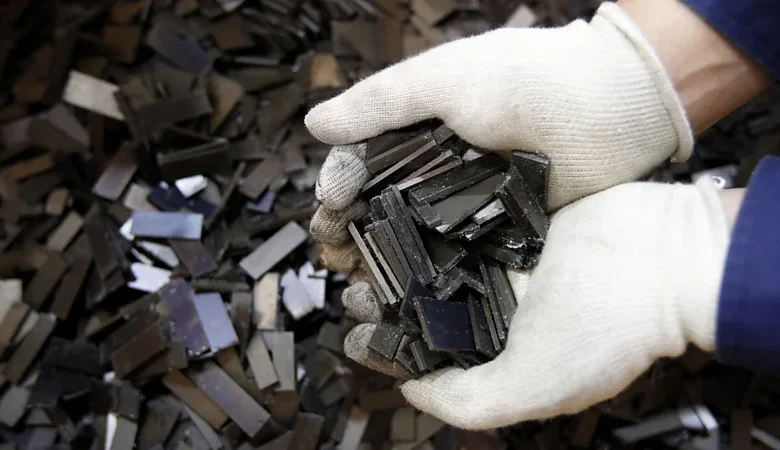
“I think that we have all the rare earth elements that we need in our waste,” says James Tour, professor of chemistry, computer science, and materials science and nano-engineering at Rice University in Texas. Tour and colleagues have developed a process for recovering rare earths from various different sources, including waste magnets.
It involves flash joule heating – wherein a material is brought to high temperatures through the application of an electric current. Electrical resistance in the material leads to the production of heat, keeping the material at temperatures reaching into the hundreds or even thousands of degrees Celsius.
Target elements within the heated material bond with a chlorine-containing compound. “We get it to stick to [chlorine] and that comes off as a vapour, we capture that,” says Michael Walshe, chief executive of Metallium, a company that has licensed the flash joule process for industrial applications.
Tour adds, “I think [it] can work on all the rare earth magnets. We’ve done it with a couple of the different, most common types, it worked on both of them.”
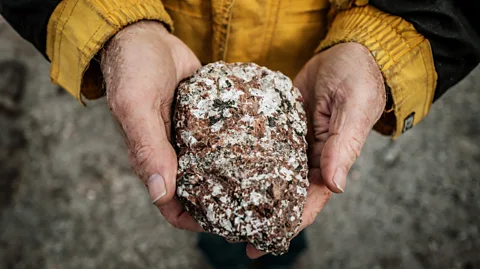
This flash joule heating method also works with rare earth-containing coal ash – left over from burning coal – and bauxite residue, or red mud, which is produced as waste when bauxite is processed to create aluminium, says Tour.
The system uses much less energy than traditional rare-earth-extraction processes, which are commonly applied to ores mined from the ground – and usually only after those ores have been shipped over long distances. Plus, the equipment required is portable. “We can put these on skids and load them on to trucks,” says Tour. However, he and his colleagues have yet to perfect the procedure for separating out the chemically similar rare earths from one another: “That’s the really hard part.”
There are many millions of tonnes of rare earth-containing coal ash and red mud lying around the US in huge waste piles, says Bridget Scanlon, a hydrogeologist in the Bureau of Economic Geography at the University of Texas at Austin. “In burning the coal, you concentrate the rare earths because the rare earths get left behind,” she says. In 2023, she and colleagues published a study that estimated the value of rare earths in US coal ash piles alone at $8.4bn (£6.2bn).
She also says that roughly 30 million tonnes of red mud is available in the US and that the rare earths within it are at roughly 10-to-20 times the concentrations found naturally in the Earth’s crust. Scanlon’s university is working with a company called ElementUSA, which is developing methods of extracting rare earths from waste including red mud. Ellis Sullivan, chief executive, says the details of how they plan to do this are proprietary but that the process will involve using acids and solvent extraction – a way of separating materials by dissolving them into different liquids.
ElementUSA plans to retrieve as much gallium and scandium, both rare earths, as possible using this approach. One of the uses of scandium, for example, could be in metal alloys that reduce the mass of aircraft – potentially by as much as 15% or more – and, therefore, the volume of fuel those aircraft need to burn. That could save huge sums of money and lower aviation emissions. Sullivan says that a prototype plant is scheduled to begin operations in 2028, with a full-scale plant following in late 2029 or early 2030.
All these approaches have promise, says Klinger. Though she stresses one point – the reason so much rare earth material is lying around in waste is because, to date, it has been costlier or more difficult to retrieve it from that waste than via conventional mining. Rare earths, despite their usefulness, do not actually command as high a price as certain other elements. “The real devil in the detail here is that rare earths are fundamentally different from, say, platinum or gold when it comes to the price point,” says Klinger.
That is why all of the projects mentioned above are considering what other materials they could harvest alongside rare earths. Carbon from coal ash could be sold to make water filters, for example. Sullivan says ElementUSA intends to extract iron as well as gallium and scandium from red mud. Meanwhile, biogas produced by the rare earth-recovering fungi could have value as a fuel.
But if any of these efforts do prove economically viable, a big prize awaits. Not just because countries may soon be able to obtain many more rare earths domestically, reducing the need for imports, but also because they could clean up contaminated environments in the process.
Gigantic heaps of coal ash, mine tailings and red mud are traditionally expensive and difficult to deal with. But if new processes allow rare earth harvesters to engage in remediation while hoovering up rare earths, then industry and environmentalists might no longer be at odds over what to do about all that waste. It would trigger “a kind of symbiosis”, adds Klinger. Like turning a fungus from a menace – into an ally.