Just how ‘excellent’ was Trump and Xi Jinping’s phone call, really?
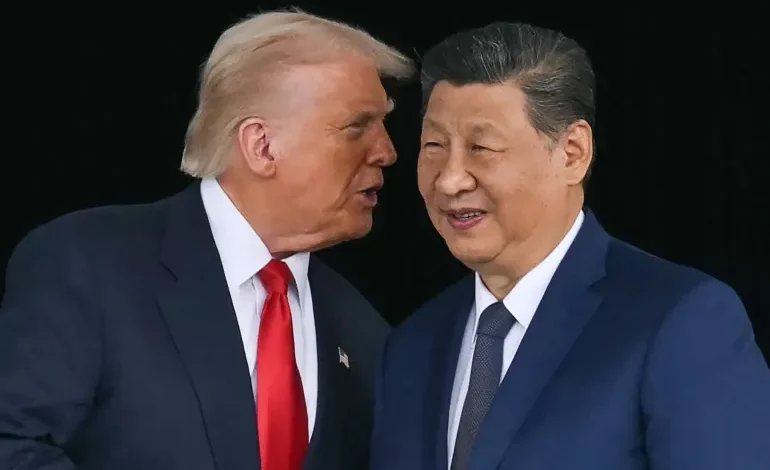
United States President Donald Trump has hailed his Wednesday phone call with his key trade rival, China’s President Xi Jinping, in which they discussed a wide range of issues, as “excellent”.
But while Trump, who hopes to persuade China to further isolate Iran, claimed after the call that China had promised to increase the volume of soya beans it buys from the US, Xi appeared more concerned with warning the US to stay away from Taiwan.
United States President Donald Trump has hailed his Wednesday phone call with his key trade rival, China’s President Xi Jinping, in which they discussed a wide range of issues, as “excellent”.
But while Trump, who hopes to persuade China to further isolate Iran, claimed after the call that China had promised to increase the volume of soya beans it buys from the US, Xi appeared more concerned with warning the US to stay away from Taiwan.
“Implicit in this is the understanding the relationship is likely to remain difficult owing to the underlying strategic competition (between them),” he added.
Beijing is set to host the Asia-Pacific Economic Cooperation (APEC) Leaders’ Meeting in November. The US, meanwhile, is hosting the G20 Summit in December.
The two leaders last held a phone call in November to discuss several topics, including trade, amid the US’s tariff war. Trump’s erratic trade policies caused Chinese exports to the US to fall, but also saw Beijing’s exports to other countries soar last year.
Here’s what we know about the latest phone call and what it means for US-China relations:
What was discussed regarding Taiwan?
Both sides confirmed that several topics were discussed, but the Chinese government, in its statement, said the “most important issue” was Taiwan.
China has long made known its plans to “reunify” with the democratic island it views as part of its own territory, and has not explicitly ruled out using force to do so.
Historically, the US has been an ally of Taiwan. Past administrations have maintained a “strategic ambiguity” position, which does not clearly rule in or out that Washington would step in to defend Taipei in case of a Chinese attack – leaving Beijing guessing.
Unlike previous governments, however, Trump has not prioritised support for Taiwan and has instead focused on making deals.
The US’s 2026 National Defense Strategy, published last month, made no mention of Taiwan, although earlier versions of it noted China’s “provocative” overtures in the waters close to Taiwan. Most recently, China held military drills in the waters and airspace around Taiwan’s main island in late December last year.
In December, the US announced a huge arms sales package to Taiwan valued at more than $10bn, including medium-range missiles, drones and howitzers, drawing anger from China.
Xi told Trump on the Wednesday phone call to handle any weapons sales to Taiwan with “prudence”, according to Chinese state media.
The Chinese leader also warned that Taiwan was part of “China’s territory”, and that China “must safeguard its own sovereignty and territorial integrity”, the Xinhua news agency reported.