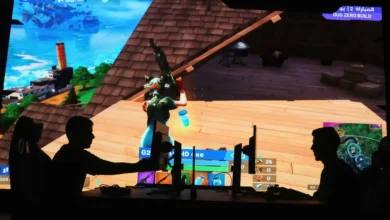
Are violent video games like Grand Theft Auto 6 becoming too realistic?
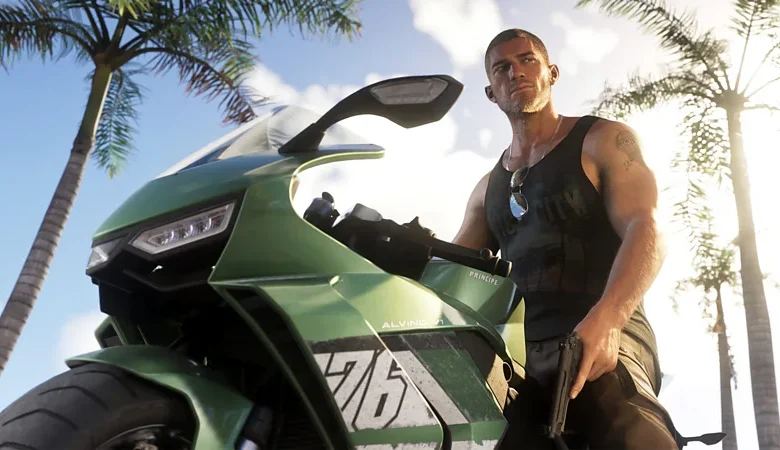
The latest in the franchise is the most hyped release of 2026 and looks set to push the boundaries of gaming visuals – but it could prove more disturbing than entertaining.
“Within 10 years, you’ll have the option to make video games look completely realistic and live-action!” So predicted Strauss Zelnick, CEO of Take-Two Interactive – the gaming powerhouse which publishes massive franchises like Grand Theft Auto and NBA 2K – during a presentation back in 2020. Yet arguably the artform of gaming has reached this milestone in less than half the time.
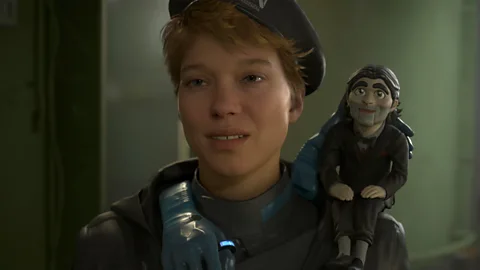
Just last year, post-apocalyptic adventure Death Stranding 2 had graphics so sharp you could see every individual strand of grass, and bask in sunlight that realistically bounced off rocks. While back in 2023, surreal supernatural thriller Alan Wake 2 depicted a mountain-side town in a way described by Euro Gamer as “boundary-breaking” and capable of making it feel like you had walked onto the set of Twin Peaks.
But the question is: do we risk creating an artform that’s so life-like it stops providing escapism away from the tensions of the real-world and – through deeper and deeper levels of immersion – starts to feel more like a misery simulator?
What to expect from GTA 6
The release pipeline for 2026 is filled with blockbuster titles set to further blur the already thin lines separating the aesthetic of our real world and its virtual equivalent. In November, the much-hyped Grand Theft Auto 6 should finally see the light of day after multiple delays. Trumpeted by its British developers Rockstar (who sit under the Take-Two Interactive umbrella) as the “largest game launch in history” and boasting a $1bn-plus budget, GTA 6 will allow gamers to navigate the fictional US state of Leonida, which promises to be a stunningly accurate 4K reproduction of real-life Florida.
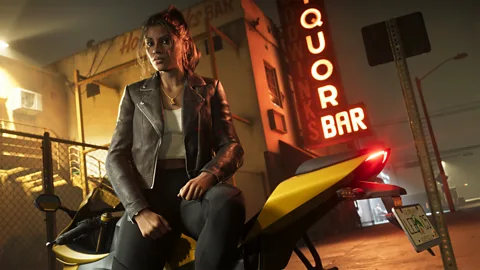
Taking control of a Bonnie and Clyde-esque pair of lead characters, Lucia and Jason, players will, as in previous instalments, steal, kill, and speed their way through this immersive experience. Based on the footage shown in preview trailers, the expectation is that the graphics for GTA 6 are going to push the processing power of the current generation of consoles (including the PlayStation 5 and Xbox Series X) to the outer limits. Among other things, Rockstar reportedly hired a separate team of 20 engineers specifically to make the water physics feel exactly like real-life waves, while eager fans have discovered intricate details hidden in the background of the trailers including raccoons eating out of rubbish bins and sharks out at sea.
“You could argue every element of a new GTA game moves forward in terms of feeling more realistic [than the last],” said former Rockstar designer Ben Hinchcliffe about GTA 6 in a recent interview. “And the realism of GTA 6 will blow people away.”
Just because a game looks ‘realistic’ doesn’t mean that it is then experienced as reality – Tanya Krzywinska
Aside from GTA 6, also upcoming is Unrecord: a first-person shooter set to boast “photo-realistic” visuals, in which you will play a police officer investigating crimes amid intimidatingly grey, brutalist concrete tower blocks. Fascinatingly, in 2023, this game’s lead developer had to take to social media to insist the viral preview videos were actually gaming graphics and not leaked body-cam footage from a real-life cop.
Meanwhile, racing game Forza Horizon 6 will utilise real-time ray tracing – a rendering technique that can realistically simulate real-world lighting – to create high-fidelity sunlight and shadow effects; driving through a neon-lit Tokyo is going to be hard to distinguish from the real thing. But now that the graphical technology is getting closer and closer to what we see outside of our windows, the argument that games are becoming too realistic, and losing their appeal as fantasies, is becoming increasingly prevalent on platforms like Reddit and X.
Then there is the fiery ongoing debate, oft-raised by politicians, about whether violence in games can be linked to increased aggression in players, and even real-life acts of violence. There is no conclusive evidence on this, but as violent games become more and more realistic, the discussion will likely only intensify. For Tanya Krzywinska, a professor of gaming at Brunel University, the issue is complicated.
How ‘real’ these games are
“While games might be capable of creating a visual illusion of reality, there are still a whole host of cues that games employ that signify them as games,” she explains, stressing that for all its visual authenticity, GTA 6 will also be consciously unreal in its use of cartoonishly silly car driving physics and an OTT narrative likely satirising both American consumerism and rampant gun culture. “Just because a game looks ‘realistic’ doesn’t mean that it is then experienced as reality,” she adds.
“Gameplay is a holistic experience involving graphics, player agency, animation, sound, ludic and spatial design – it’s the meshing together of these in compelling and well-integrated ways that I think invites interest for a player. Not just graphics alone.” Yet Tracy Fullerton, professor and director of the Game Innovation Lab at the University of Southern California School of Cinematic Arts, says it’s also easy to understand why some gamers might be feeling somewhat overwhelmed by big-budget games’ recent graphical leaps.
“Sometimes I want to play with characters that look just like the real life sports stars. Isn’t there a kind of magic in that?” she explains, “but [blockbuster] games have also created a cycle of greater and greater expectations for players around graphic technology that is quite different and has a very different price tag associated with it. Sometimes that rising level of [visuals] does feel like magic, and sometimes it feels unnecessary, and possibly even too much.”
Rasheed Abudeideh, the Palestinian developer of upcoming indie game Dreams on a Pillow, worries that games like GTA 6 will create a moment where gaming violence becomes uncomfortably close to acts of real-life terrorism, war, and murder. “I think we already live in a very dark and chaotic world, and in that context, it feels even more disturbing to develop games that revolve primarily around realistic acts of killing,” he explains.
Games, he believes, should “ultimately [be] about fun, about engaging the player and keeping them in a ‘flow state'” – a meditative frame of mind which he says “can be achieved with very simple, even basic technology. What truly makes the difference is creativity in game design, not visual fidelity. Realism can be a powerful tool to increase immersion, but it’s not the goal in itself.”
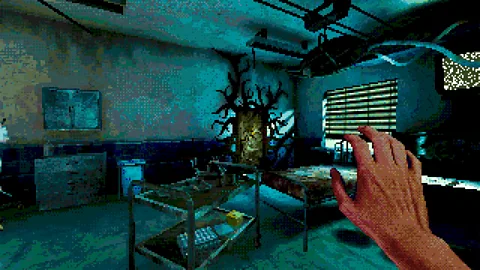
Indeed, over recent years, there have been signs that gamers care less about graphical fidelity than about uniquely lo-fi art styles. Big-budget gaming studios (including Electronic Arts) have suffered mass redundancies, and often struggled to get their blockbuster games finished or off the ground: GTA 6, for example, is arriving 14 years after GTA 5. Conversely, independent gaming studios have flourished, putting out innovative games which aren’t defined by lifelike graphics and have more of a through-line with the 8- and 16-bit eras of 2D gaming.
The best-selling console of the 2020s by some distance has been the Nintendo Switch. Its games have a fairytale vibrancy and graphical capabilities more in line with a PlayStation 3 than a PlayStation 5 – a clear sign that realistic graphics aren’t the be-all and end-all for every player.
The titles bucking the trend
One of the best games of 2025, the survival horror indie title Eclipsium, embraces fuzzy VHS textures and offers Lynchian surrealism through a glitchy lens. “I’ve always believed that the purpose of media is to communicate a feeling, not necessarily to create a completely accurate replica of something,” its developer Emil Forsén tells the BBC of its bold visual style.
Realistic graphics alone aren’t a major selling point for players anymore. It’s the experience, the fantasy that will draw them in – Francis Coulombe
“There’s a renaissance for indie games right now,” Forsén adds. “I definitely think that hyper-realism doesn’t have the same allure that it used to, and the people buying games based on graphics alone are a pretty small gang.” Francis Coulombe, the developer of Look Outside, a 2025 indie title that looks like David Cronenberg made a body-horror game for Sega’s old-school Genesis, aka Mega Drive console, says that the business of producing hyper-realistic, blockbuster games is less sustainable than it was in the past, with enormous pressure put on development staff to reach ambitious targets and work unrealistic hours.
“Realism tends to be an expensive, dangerous path to take. It puts you in a big pond with the big fish.” Speaking specifically about his own game, Coulombe continues: “I like when horror has a touch of absurdity, when it is very nearly funny, colourful, even goofy. That does help bring a certain nightmarish feel to the visuals of Look Outside. It would be much harder to deliver this through a more realistic art style.”
Another gaming highlight of 2025 was Tiny Bookshop, a vibrant hand-drawn experience where you open a literary retail operation in the heart of a sunny seaside town filled with Roald Dahl-like eccentric locals. Developed by Neoludic games, Tiny Bookshop is from the so-called “Cosy Gaming” sub-genre. This is a rising market, allowing gamers a gentler, more life-affirming alternative to shooting enemies.
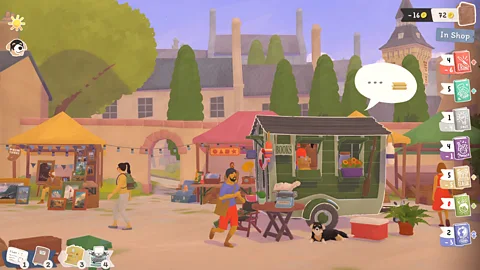
Zapfe-Wildemann claims that “realistic graphics alone aren’t a major selling point for players anymore. It’s the experience, the fantasy, the promise of the game that will draw you in.” He says that gamers now appreciate the sense of Fernweh – a German word referring to the desire to see far-flung places; he relates this to “that pandemic-led feeling of wanting to be somewhere else where time stops”. For Coulombe, hyper-realism can ultimately hinder gaming experiences, because “you can end up with games that look very real in a purely cosmetic visual sense, but need to compensate for this with contrived level design, so the players don’t get lost or overwhelmed”.
“Many fail to do this,” he adds. “Back when 3D games looked more simple, a lot of level design felt more natural.” This, he theorised, is a big driver of the current retro gaming boom, where old consoles like the PlayStation 1 and Nintendo 64 still sell strongly, as Gen Z pines for nostalgic analogue-era experiences.
GTA 6 could well deliver in terms of gaming experience as well as graphics, given the pedigree of the franchise. But what could the impact of its near-photographic visuals be on players? It certainly has the potential to lead some grim sights online – streamers creating TikToks of themselves merrily playing the game and committing brutal acts, as was the case with GTA 5.
But equally it could mean the nefarious acts players commit within the Grand Theft Auto 6 world carry more emotional weight, and prompt gamers to examine their choices. In fact, Coulombe predicts GTA 6 will be less realistic than the trailers suggest. “If the developer Rockstar still intends for players to treat the games as playful sandboxes for mayhem, realism taken to extremes could make some players shy about experimenting in that space, so I expect their realism will be more selective.”
Whether you prefer hyper-realistic graphics, or ones that look like they were doodled onto paper during a fever dream, Fullerton just hopes that an appreciation for gaming experiences of all styles continues to flourish. She says that, fortunately, those overwhelmed by photo-realistic gaming characters now have plenty of alternatives. “Sometimes players are in the mood for a cosy game, sometimes for a challenging indie platformer, and sometimes for a hardcore action-adventure game,” she says. “Each gaming experience needs to be valued on its own aesthetic terms.”