The prehistoric shark found in a suburban town in Scotland
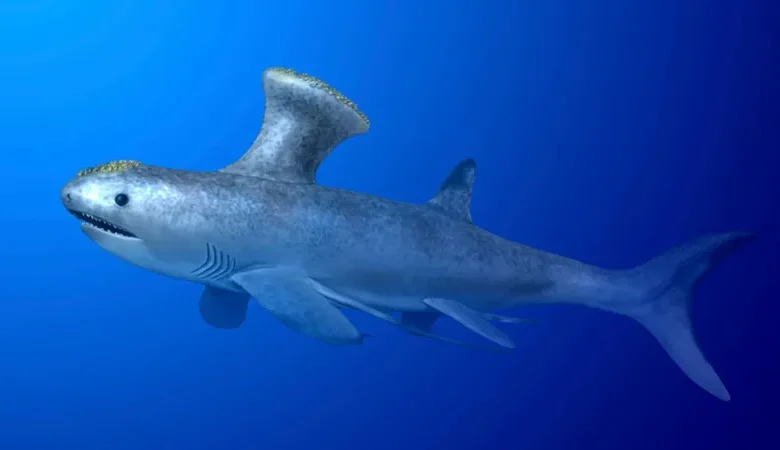
Think of sharks and the most common images that spring to mind will likely be of dangerous predators hunting prey, accompanied by ominous music.
However, a town in the leafy suburbs of Glasgow has its own connection to the famous fish – and it dates back millions of years.
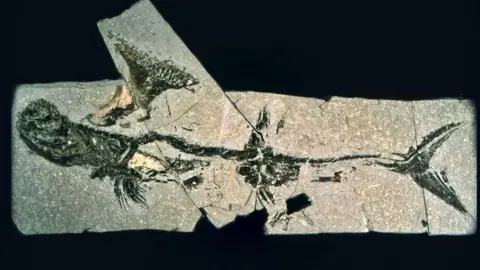
In 1982 a complete shark fossil was discovered in Bearsden, in East Dunbartonshire.
It was so complete experts could even see the remains of the last meal eaten by the fish, 330 million years after it died.
Now a group of local enthusiasts are hoping to install a sculpture of the fish in the town, ensuring the tale of the Bearsden Shark will be remembered for future generations.
The one metre long shark – officially named as the Akmonistion zangerli – was discovered at the Manse Burn in Bearsden, among dozens of other fish and plant samples found during an excavation of the site.
According to local legend, some boys in the area had discovered fossils and brought them to the attention of Bearden fossil hunter Stan Wood, at that time working at the Hunterian Museum in Glasgow.
He arranged for the excavation to take place throughout the summer of 1982, with the Bearsden shark the most exciting find.
“It’s the most complete fossil shark of any kind, anywhere, of any age,” says Dr Neil Clark, the curator of palaeontology at the Hunterian.
“It’s totally preserved, so every vertebrae and every tooth is in the place it was when it was alive. It’s a very useful fossil for understanding what these sharks are like, as before we usually worked with just pieces of teeth or the head.
“For something like the megalodon (usually portrayed in various action and horror films as gigantic) we have no idea how big it really was because we just have the teeth to go on.
“These sharks became extinct during the Triassic period when around 96 per cent of creatures died out – that was far more than during the Cretaceous period which marked the end of the dinosaurs. “
Given this was hundreds of millions of years ago, Scotland bore no resemblance to the land it is today, instead being located near the equator.
“What is now Bearsden was part of a lagoon,” explains Neil Buchanan, an enthusiast on the shark.
“That lent to the type of fish that were there, shrimps and the like. Then there was some sort of catastrophic event for the shark, which killed it, but it seemed to sink into mud.”
Yet while soft tissue usually rots away, the lack of oxygen caused by the manner of the shark’s death and more mud landing on top preserved the fish.
A plaque on a small cairn already marks where the discovery was made, but Mr Buchanan and others in the Bearsden Shark Group would now like to see a sculpture in the town as a memento of the shark.
“People are beginning to forget about it, ” he says.
“You mention the Bearsden shark to people and sometimes they have no idea about it.
“One of the things we have come to realise is that the site itself is isolated from the population, so we came up with the idea of a permanent display in the town centre.
“The quality would hopefully be attractive enough for people locally to look at, and maybe even have visitors come.”

Despite the shark being so well preserved, Dr Clark says there remain many mysteries about the fish found in a Bearsden burn.
“There is still a lot to be found out about them, especially the structure behind the head,” he explains.
“There are a lot of different theories. At the time it was found they thought maybe it arched its back and make it look like a huge mouth, but it’s so narrow it wouldn’t actually look like a mouth, so that theory is out the window.
“Another theory has it as a male shark and perhaps it was a purpose in mating, like for scratching females.
“There is still so much more to be found about these creatures, but we may never discover it.
“Research is still ongoing regarding the things dug out of Bearsden and there’s always something new coming out from them – that’s what is so magical about it.”