A Gaza family split by medical evacuation hopes transplant could unite them
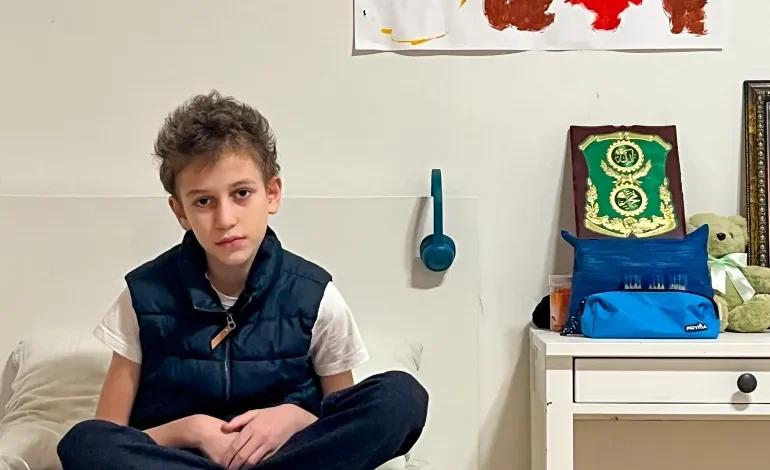
Abdullah, 10, barely lifts his gaze from his tablet as he plays his favourite video game, where he creates a virtual universe that lets him be anything he imagines.
The beeping of the chemotherapy infusion pump delivering drugs into his veins briefly brings his attention back, and he fumbles for the charger of the plug-in device before resuming his game.
His mother, Iman Ismail Mohammad Abu Mazid, says he picked up the gaming habit after leaving Gaza on May 14 for the Italian city of Padova to receive life-saving treatment for leukaemia.
Back in Deir el-Balah, the city in central Gaza that the family called home, he was a “very sociable child” who “would always be in the streets playing football with his brothers and other children his age,” she told Al Jazeera, before looking through her phone to retrieve a picture of the boy she remembers.
In it, three well-groomed children look at the camera. Abdullah has the same calm look, but his hair is now longer and his skin has a tinge of yellow. Standing beside him in the picture is Mohammad, who is now 11, and Mahmoud, who is eight. Towering above them and proudly placing his arms on their shoulders is their father, Ahmad.
The cancer that consumes Abdullah also tore their family apart.
While Abdullah, his mother Iman and one-year-old Qamar were granted seats on a medical evacuation flight that took them to Italy, the rest of the family – Ahmad and the other two children, Mohammad and Mahmoud – stayed behind in Gaza, which Israel continues to bomb despite a ceasefire agreement being in place.
Now the disease could be what brings them back together. In early November, a team of doctors in Gaza took blood samples from Abdullah’s siblings and sent them to Italy to determine their compatibility as donors for the boy’s marrow transplant.
If one is a match, they will all be allowed onto a medical flight to Padova. If the results are negative, they will need to apply to the Italian government for family reunion – a much longer process fraught with logistical challenges.
Iman said the fate of his family hangs on those results. They could save Abdullah from the disease, and the rest of their family from Israel’s genocidal war on Gaza.
“I fear for their safety every day,” she said. “Abdullah misses his siblings, and I miss my children, too.”
Abdullah shyly nodded in confirmation, adding that he misses a nicely done kebab, too. He has no penchant for Italian food and reminisces about the seasoned meat the family’s go-to restaurant in Deir el-Balah served.
Asked whether he would like to bring Gaza to Padova, he said, “Not all of it, just my neighbourhood.”
Escaping war in Gaza
Iman found out she was pregnant with Qamar in March 2024, as the war was raging around her. At first, she thought her period had skipped because she had been barely surviving on water and bread. When it became apparent that a fourth child was on the way, she recalls feeling “terrified”.
“I was constantly worried and anxious that they’d tell me the baby was deformed, abnormal, sick,” because of the lack of food and sanitation, she said. “My body was exhausted, and I couldn’t stand. I spent my entire pregnancy lying on the floor,” she says rapidly in Arabic, before picking up the toddler tugging insistently at her leg and placing her on her lap to feed her.
Her baby girl was delivered in a tented field hospital in Deir el-Balah that lacked basic sanitation and medicines, as victims of Israeli bombardment were rushed in.
“You could see someone injured at any moment – an amputated limb, an amputated hand … The scenes were horrific,” she said. “And the doctors were nervous because the area was being targeted.”
Months later, in April this year, Abdullah started feeling sick.
“He was yellow, had abdominal cramps, a headache,” she said.
At the Al-Aqsa Hospital in Deir el-Balah, Abdullah was strapped to an IV and given painkillers and antibiotics. The fluids kept the fever from spiking, but nothing could stop the cancer from spreading.
The family was advised to take him to the European Hospital in Khan Younis, despite the Israeli army having announced a major expansion of military operations in the area.